Wild World Cup Goals: Amazing Stories & Soccer Skills
Introduction: The Magic of the World Cup
Picture a sea of flags waving under a bright sun, the smell of fresh-cut green grass, and a roar from the crowd so loud it makes the ground shake. This is the World Cup, the biggest soccer tournament on the planet. Every four years, countries from every corner of the globe come together to compete for the ultimate prize, while millions of fans hold their breath at every turn.
In soccer, the most electric moment of all is the goal. Simply put, a goal is when the ball finds its way into the back of the net. But some goals are more than just points on a scoreboard; they are "wild." A wild goal is a moment of pure soccer magic, something crazy, surprising, or so amazing it feels impossible. These stories are a wonderful way for parents and educators to spark a child’s imagination and explore the drama and heart of the world’s most popular sport.
What Makes a Goal "Wild"?
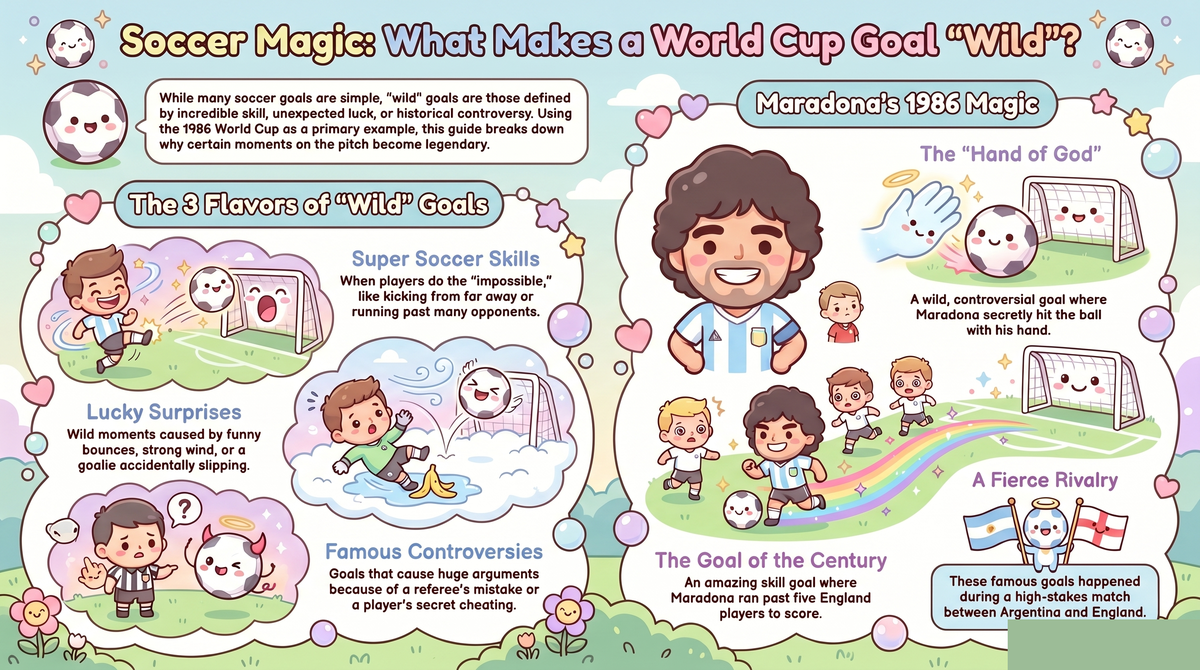
Not every goal is a simple kick into the net. To be truly wild, a goal usually falls into one of these four categories:
- Skill That Amazes: These goals show off incredible practice and talent. They involve players doing the unthinkable, launching a ball from a massive distance, weaving through a crowd of opponents, or striking a ball perfectly while it is still flying through the air. These are the moments that make us ask, "How did they do that?"
- Surprise and Luck: Sometimes, soccer is unpredictable. A sudden gust of wind, a goalie slipping on the grass, or a ball taking a funny bounce can lead to a goal no one saw coming. These goals are wild because they remind us that anything can happen in a split second.
- Big Importance: Some goals are wild because of when they happen. A goal scored in the final heartbeat of a game or during the championship match to win the whole tournament makes a player a hero. These become the stories we tell for generations.
- Controversy: A goal can be wild because it starts a massive argument. If a player breaks a rule or a referee makes a mistake, the goal becomes a legend for the debate it creates. These are moments that fans and experts still talk about decades later.
A Tale of Two Goals: Diego Maradona (1986)
The most famous display of soccer magic took place during the 1986 World Cup in Mexico. The atmosphere was tense as Argentina faced off against England. The two teams were fierce rivals, and the score was locked in a 0-0 stalemate. Argentina needed a spark, and they found it in Diego Maradona. He was a whirlwind on the grass, small, lightning-fast, and a master with the ball.
The "Hand of God"
The first goal Maradona scored that day is perhaps the most famous argument in sports history. As the ball floated high into the air, Maradona leaped against the much taller English goalkeeper. In a split-second blur of movement, Maradona used his hand to punch the ball into the net. The officials didn't see the trick, and the goal was allowed to stand.
Maradona later famously said the goal was scored "a little with the head of Maradona and a little with the hand of God." While the English players were furious at the deception, the goal remains legendary. Even today, decades later, people still debate the play, proving that controversy is a powerful part of soccer history.
The "Goal of the Century"
Just minutes after that "naughty" moment, Maradona showed the world the "best" side of soccer. Receiving the ball in his own half of the field, an enormous distance from the net, he began a run that looked like a dance. The ball seemed glued to his feet as he sprinted and weaved. He dribbled past five English defenders, leaving them in his wake, before sliding the ball into the net to score again. This display of pure, impossible talent is known as the Goal of the Century. In one single game, Maradona showed us both sides of "wild" soccer: a goal that caused a huge debate and a goal that showed world-class skill.
Conclusion: Why We Remember the Magic
We remember these wild goals because they capture the unexpected heart of the game. Whether it is a lucky accident, a moment of high drama, or a display of perfection, these moments stay with us long after the whistle blows. For parents and educators, these tales are more than just sports stories; they are a way to talk with kids about the importance of hard work, the role of luck, and the rules that guide the games we love.
Frequently Asked Questions (FAQ)
Q: What does it mean when a goal is "controversial"? A: It means the goal caused a big argument! This usually happens if a player breaks a rule, like using their hand, and the referee doesn't see it, or if people think a mistake was made.
Q: Why was Diego Maradona’s 1986 performance so famous? A: It’s famous because he showed two totally different sides of soccer in just a few minutes. He scored the "naughtiest" goal in history with the Hand of God, and then the "best" goal ever with the Goal of the Century.
Q: Can a goal be "wild" if it was just a lucky accident? A: Absolutely! Surprises like a big gust of wind or a goalie slipping on the grass are wild because they are totally unexpected and can change the whole game in a heartbeat.
Q: How often does the World Cup happen? A: The World Cup happens every four years, bringing countries from all over the world together to play on the biggest stage of all.
Turn this into action, a hands-on, printable mission made for this episode.
The Ranger Field Mission
Run this after every episode to turn listening into something your child actually keeps. Do as many steps as they have energy for — even one counts.
- 1
Say it back
Before snacks or screens, ask your Ranger to teach you the one big idea — as if you'd never heard it.
- 2
Find it in the wild
Hunt for one real example of today's idea — in the kitchen, the yard, the sky, or the sidewalk. Point at it and name it.
- 3
Make something
Draw it, build it from what's on the table, act it out, or record a 20-second “Ranger report.” Making it forces real understanding.
- 4
Ask the next question
Finish with “What's one thing the episode didn't answer?” Stick it on the fridge — that's the start of the next adventure.
This article is part of Parenting With Purpose - free tools and companion guides that turn everyday moments into real learning. Explore the Discovery Rangers podcast kits, browse The Library, or build a calm weekly rhythm with The Sunday Plan.