
Sloth vs Turtle Race: Who's Slower?
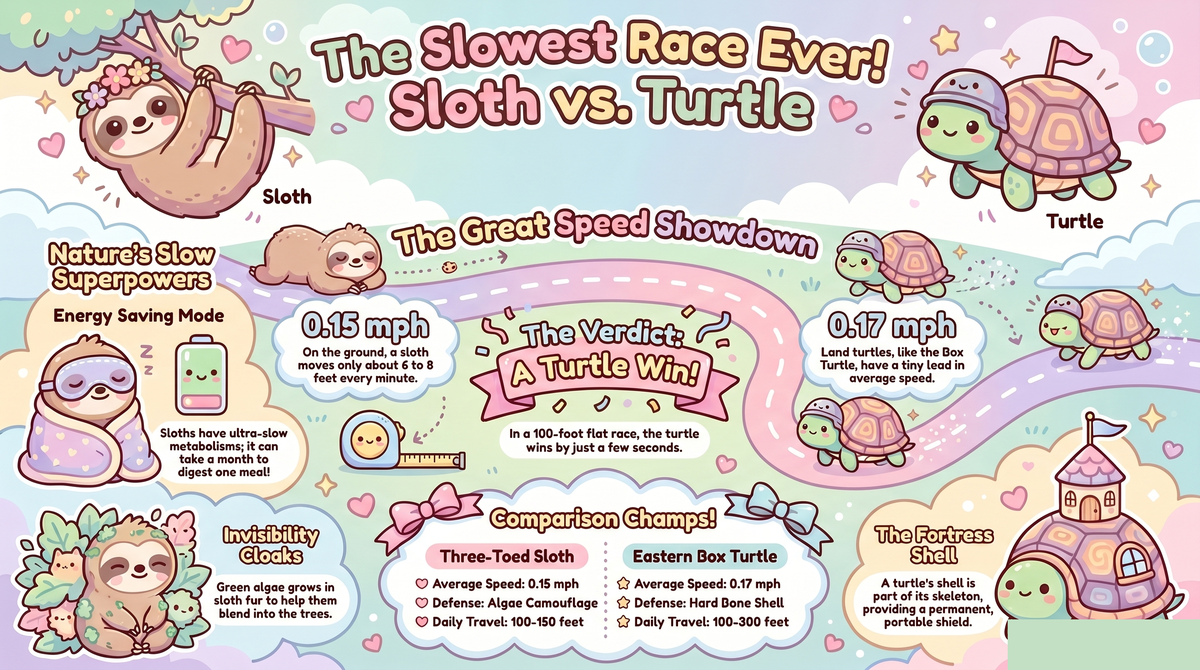
Could a sloth win a race against a turtle? It sounds like the setup for a joke, doesn't it? Both are famous for their slow-motion lifestyles. But zoom in with a naturalist's eye, and you'll see that "slowness" isn't a flaw. It's a biological superpower.
Turtles have been mastering this slow strategy for over 200 million years. That's right, they were ambling around Earth before the first dinosaurs showed up! We're going to explore these two contenders, check out the science behind how they survive, and figure out who'd actually cross the finish line first.
Meet the Contenders: Nature’s Slow-Motion Stars
To understand the race, we have to look at how these animals are built. Every part of their body is a tool designed for a very specific way of life.
The Sloth
These guys hail from the lush rainforests of Central and South America. Sloths are arboreal specialists, meaning they're built to live high up in the trees. Their survival kit includes:
- Algae Camouflage: A sloth’s fur isn't just hair; it’s a living ecosystem! Green algae grow in the coarse strands, creating a natural "invisibility cloak" that hides them from hungry jaguars and eagles.
- Super-Slow Metabolism: Metabolism is how your body turns food into energy. Sloths eat leaves that offer very little nutrition, so they've evolved one of the slowest metabolisms of any mammal. It can take a whole month for a sloth to digest just one meal!
- Hook-like Claws: These long, curved claws let the sloth hang effortlessly from branches. They save so much energy this way that they can even stay tucked into a ball while fast asleep.
The Turtle
Sea turtles are graceful swimmers, but land-dwelling species like the Eastern Box turtle or the Desert tortoise are built for endurance on the forest floor.
- The Shell Structure: A turtle’s shell is a permanent part of its body, fused to its spine and ribs. It's made of the carapace (the top), the plastron (the bottom), and hard outer plates called scutes.
- Beaks, Not Teeth: Unlike most mammals, turtles don’t have teeth. Instead, they have powerful, sharp beaks used to snip through plants or mushrooms.
- Legendary Longevity: By living life in the slow lane, turtles are masters of survival. Some species, like the Galápagos tortoise, can live for well over 100 years.
💡 Did You Know?
- The Sloth’s Secret View: Sloths can turn their heads up to 270 degrees, almost all the way around like an owl! This lets them spot predators without wasting energy moving their bodies.
- The Giant of the Sea: The Leatherback sea turtle can grow to be 6 feet long and weigh as much as 2,000 pounds, as much as a small car! However, on land, they are very slow and awkward.
The Speed Showdown: Data by the Numbers
When we put the numbers side-by-side, the competition is closer than you might think. Here is the statistical breakdown for a Three-Toed Sloth versus an Eastern Box Turtle:
| Feature | Three-Toed Sloth | Eastern Box Turtle |
|---|---|---|
| Average Speed | 0.15 mph (0.24 kph) | 0.17 mph (0.27 kph) |
| Top Speed (Short Bursts) | ~0.20 mph | ~0.20 mph |
| Primary Habitat | Rainforest Canopy | Forest Floor / Grasslands |
| Defense Mechanism | Camouflage & Stillness | Armored Shell |
| Daily Movement | 100-150 Feet | 100-300 Feet |
The Big Race: A Play-by-Play Analysis
Imagine a 100-foot path on soft forest soil. At the "Go!" signal, our racers begin.
The sloth must descend from a branch and start a rhythmic, steady crawl. On the ground, the sloth moves at a rate of roughly 6 to 8 feet per minute, dragging its body forward as its long claws grip the soil. Meanwhile, the turtle pokes its head out and begins a determined waddle. You might hear the faint "clunk" of its heavy shell against the earth as its sturdy, stubby legs push forward.
The Verdict: Based on average speeds, the turtle would win by a small margin. Because it averages 0.17 mph compared to the sloth’s 0.15 mph, the turtle would reach the finish line just a few minutes ahead of its furry friend.
The "What If" Factors:
- The "Scared Sprint": If a predator appeared, a desert tortoise could "sprint" up to 0.2 mph, potentially widening the lead. Sloths rarely panic; they prefer to stay perfectly still.
- Rainy Conditions: Sloths have fur designed to shed water efficiently, while a turtle might find the mud slippery and difficult for its heavy frame.
- Natural Obstacles: Over tangled roots or fallen branches, the sloth's climbing claws give it a major advantage over the turtle’s low-clearance shell.
The Deeper Lesson: Why Slow is a Winning Strategy
For parents and teachers, this race is a wonderful way to explain Energy Conservation. In nature, every movement costs "fuel" (calories). High-energy animals like cheetahs can hit 70 mph, but they run out of gas in seconds. Sloths and turtles have chosen a different path:
- Saving Energy: Since leaves and berries don't provide much "fuel," moving slowly ensures these animals don't spend more energy than they take in.
- Avoiding Detection: Most predators hunt by looking for fast movement. By moving slowly and using camouflage, these animals stay "under the radar."
- Reducing Risk: Slower movement means fewer accidents and less chance of bumping into a rival.
- Matching the Food: Since their food doesn't run away, they don't need speed to catch a meal!
Conclusion and Educator Takeaways
The race between the sloth and the turtle reminds us that there is no single definition of "success." Every creature is built perfectly for the environment it calls home. In the classroom or at the dinner table, we can use these "slow-lane champions" to teach children that patience and efficiency are just as valuable as speed and strength.
Key Takeaways for the Classroom or Home:
- Form Follows Function: An animal’s physical traits (like hook claws or a bony shell) are clues that tell us how and where they survive.
- Energy is a Budget: Just like money, energy must be spent wisely. Being slow is a brilliant way for an animal to "save" its energy for when it’s needed most.
- Success is Relative: We shouldn't judge a sloth by its ability to run, nor a turtle by its ability to climb. Every animal is a winner in its own habitat.
Parent & Teacher FAQ
How often do sloths leave the trees? Sloths usually come down to the ground only once a week to use the bathroom. This is a very dangerous time for them, but it’s a fascinating part of the ecosystem, special moths actually live in the sloth's fur and depend on these weekly trips to the forest floor to survive and lay eggs!
Is a turtle's shell part of its body? Yes! A turtle cannot "crawl out" of its shell like a cartoon. The shell is made of bone and is a permanent part of the turtle’s skeleton, attached directly to its spine and ribs.
Which animal moves faster, a snail or a sloth? The sloth is the winner here! While 0.15 mph seems slow to us, a sloth is actually five times faster than a snail, which moves at a tiny 0.03 mph.
How do sloths stay hidden? They use a "two-step" defense. First, they stay extremely still to avoid being seen. Second, they allow green algae to grow in their fur, which acts as a living suit of camouflage that blends perfectly into the rainforest leaves.
Turn this into action, a hands-on, printable mission made for this episode.
The Ranger Field Mission
Run this after every episode to turn listening into something your child actually keeps. Do as many steps as they have energy for — even one counts.
- 1
Say it back
Before snacks or screens, ask your Ranger to teach you the one big idea — as if you'd never heard it.
- 2
Find it in the wild
Hunt for one real example of today's idea — in the kitchen, the yard, the sky, or the sidewalk. Point at it and name it.
- 3
Make something
Draw it, build it from what's on the table, act it out, or record a 20-second “Ranger report.” Making it forces real understanding.
- 4
Ask the next question
Finish with “What's one thing the episode didn't answer?” Stick it on the fridge — that's the start of the next adventure.
This article is part of Parenting With Purpose - free tools and companion guides that turn everyday moments into real learning. Explore the Discovery Rangers podcast kits, browse The Library, or build a calm weekly rhythm with The Sunday Plan.