
Mars Drones Break Sound Barrier: Supersonic Speeds on the Red Planet
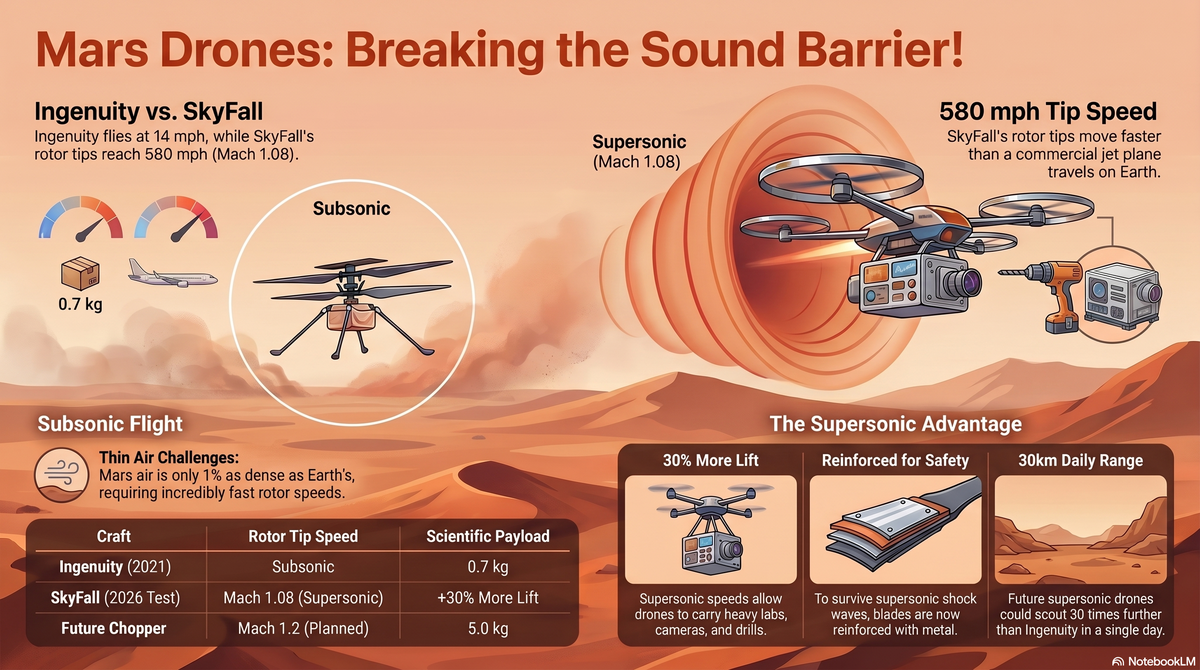
On Mars, a helicopter just spun its blades so fast the tips broke the sound barrier. something no aircraft on Earth does. Get ready to talk about speed on a whole other planet! In this episode of Discovery Rangers, we’re blasting off to Mars to explore how our robotic explorers, specifically their amazing flying drones, are achieving speeds we used to only dream of for aircraft. Get ready to discover what "supersonic" really means and why it’s a breakthrough for exploring the Red Planet!
1. Introducing Our Martian Flyers
For years, we’ve sent incredible robots to Mars, like rovers that trundle across the dusty plains. But recently, we’ve added a new kind of explorer: tiny, flying robots called drones, or helicopters. Think of them as super-advanced remote-controlled toys, but instead of exploring your backyard, they're exploring an entire planet! The first of these brave flyers was the Ingenuity helicopter, which proved that flying in Mars’ thin atmosphere was possible. Now, scientists are pushing the limits even further, and the latest tests show that the rotor blades on these future Mars drones can spin faster than the speed of sound on Mars! This is a huge leap forward, and understanding this "supersonic" speed is key to unlocking even more incredible discoveries.
2. What Exactly Is "Supersonic"?
It sounds like something out of a science fiction movie, doesn't it? "Supersonic" means moving faster than the speed of sound. But let's break that down.
- Sound: You know how when you clap your hands, you hear a noise? That noise is sound, and it's created by vibrations that travel through the air to your ears.
- Speed of Sound: This is simply how fast those sound vibrations travel through the air. On Earth, at sea level, sound travels at about 343 meters per second, which is around 1,236 kilometers per hour (or 767 miles per hour). That's really, really fast!
- Mach: This is a special way scientists measure speed when things get really fast. It's a number that tells you how many times faster something is going than the speed of sound. So, Mach 1 is exactly the speed of sound. Mach 2 means you're going twice as fast as sound.
- Supersonic: When something moves faster than Mach 1, it's going supersonic.
When an object breaks the sound barrier, it creates a shock wave. On Earth, this is what causes that famous loud "sonic boom" you might hear from a jet plane. On Mars, the air is much thinner, so any boom would be much quieter, but it's still a sign that something incredible is happening with speed!
Fun Fact: The speed of sound isn't the same everywhere! It changes depending on the air. On Mars, the air is much colder and thinner than on Earth. This means sound travels slower there.
3. The Speed of Sound on Mars
So, how fast is the speed of sound on Mars? Scientists have figured this out, and it's quite interesting. Using the Perseverance rover, they measured it at about 240 meters per second, which is roughly 540 miles per hour. This is significantly slower than on Earth. Why? Because the Martian atmosphere is incredibly thin, it's only about 1% as dense as Earth's atmosphere!
Imagine trying to swim in a pool filled with thick syrup versus swimming in a pool filled with water. The syrup is much harder to move through. Similarly, the thin air on Mars makes it harder for sound waves to travel quickly. This thin air also presents a challenge for flying machines. To create enough "lift" to get off the ground and stay airborne, a helicopter on Mars needs to spin its rotor blades much, much faster than a helicopter on Earth.
4. How Fast Do Our Martian Drones Fly?
Let's look at how our robotic explorers are doing in terms of speed.
Ingenuity: The Pioneer
The first Mars helicopter, Ingenuity, was a true trailblazer. It weighed less than a kilogram (about 1.5 pounds) on Mars, super light! Its rotor blades were about 1.2 meters (4 feet) across, which is quite large for such a small craft. During its record-breaking flights, Ingenuity reached a top speed of about 14.5 miles per hour. Its usual cruising speed was around 12 miles per hour. These speeds are impressive for a tiny robot on another planet, but they are nowhere near supersonic. Ingenuity’s blades spun at about 2,700 revolutions per minute (rpm) during normal flights. This was fast enough to keep it flying in the thin Martian air, proving that flight was possible.
SkyFall: The Next Generation
Now, scientists are developing bigger and more capable Mars helicopters, like the one being tested under the SkyFall project. In 2026, tests were conducted in a special simulator that mimics Martian conditions. During these tests, the tips of the rotor blades on a new design actually broke the sound barrier, reaching an incredible Mach 1.08! This means the tips of the blades were spinning 1.08 times faster than the speed of sound on Mars.
These tests showed that when the rotor tips went supersonic, the helicopter got a 30% increase in lift. This extra power is hugely important because it means future helicopters like SkyFall could carry much heavier equipment. Imagine strapping on bigger cameras, more advanced scientific tools, or even mini-labs to explore Mars in greater detail!
Fun Fact: Mach 1.08 on Mars is about 580 miles per hour! That's faster than most commercial airplanes fly on Earth.
5. Supersonic Speeds: A Comparison
It’s fascinating to see how these Mars drones stack up against other fast-moving vehicles we know.
- Ingenuity: Flew at speeds far, far below the speed of sound on Mars (around 12-14 mph).
- SkyFall Test Rotor Tip: Reached Mach 1.08, about 580 mph, in simulated Martian conditions.
- Concorde (Earth): This famous supersonic passenger jet flew at Mach 2, or about 1,350 mph.
- X-59 Quiet Supersonic Aircraft (Earth): A new experimental plane designed to fly between Mach 1.1 and Mach 1.4 (around 713-925 mph) and make a quieter "thump" instead of a loud boom.
- F-22 Raptor (Earth): A military jet that can reach speeds of Mach 1.5 to Mach 2 (around 1,000-1,350 mph).
It’s amazing to think that a tiny drone, designed to fly in the thin air of Mars, is now achieving speeds comparable to some of Earth's fastest aircraft!
Try This at Home: Grab a piece of paper and a pencil. Can you draw a picture of what you imagine a future Mars helicopter with super-fast spinning blades might look like? Think about how it might be different from Ingenuity or a helicopter you see on Earth. Maybe it has bigger blades, a stronger frame, or special scientific tools attached!
6. Why Does Going Supersonic Matter for Mars?
So, why is all this fuss about breaking the sound barrier on Mars? It boils down to a few key reasons:
- More Lift: As we saw with SkyFall, when the rotor blade tips go supersonic, they create significantly more lift. This is crucial for flying in Mars' very thin atmosphere. More lift means the helicopter can carry more weight.
- Carrying More Science: With more lift, future Mars helicopters can be equipped with heavier and more sophisticated scientific instruments. This means they can collect more data, take higher-resolution images, analyze rocks and soil in more detail, and help us understand Mars better than ever before.
- Faster Exploration: While the main body of the helicopter might not be moving at supersonic speeds, the rotors are the engine for flight. Faster rotor speeds (even if the tips are supersonic) can potentially lead to quicker flights or the ability to cover more ground during a mission.
- Overcoming Martian Challenges: The thin atmosphere is a constant challenge for flight on Mars. Achieving supersonic rotor speeds is a clever engineering solution that allows our robotic explorers to overcome this hurdle and perform more complex aerial maneuvers.
The development of supersonic rotor speeds for Mars drones shows human cleverness and our relentless drive to explore. It’s a significant step towards unlocking the secrets of the Red Planet, one super-fast spin at a time!
Frequently Asked Questions (FAQ)
Q: Will the Mars drones make a sonic boom like on Earth? A: While the rotor tips will create shock waves when they go supersonic, the sound they make on Mars will be much quieter than a sonic boom on Earth. This is because the Martian atmosphere is so much thinner than Earth's atmosphere.
Q: How fast is Mach 1 on Mars compared to Earth? A: Mach 1 on Mars is about 540 mph (240 m/s), while Mach 1 on Earth at sea level is about 767 mph (343 m/s). So, the speed of sound is slower on Mars.
Q: Does the whole helicopter move at 580 mph? A: No, typically only the very tips of the rotor blades reach supersonic speeds. The main body of the helicopter will be moving much slower, similar to how the body of a jet plane moves slower than its wingtips.
Q: Why can't helicopters on Earth just spin their blades faster to get more lift? A: Helicopters on Earth have a much thicker atmosphere to work with, so they don't need to spin their blades as fast to generate lift. Also, spinning blades too fast on Earth can cause other problems, like increased drag and stress on the materials.
Q: What kind of science instruments could a supersonic Mars drone carry? A: Future supersonic Mars drones could carry things like advanced cameras for detailed mapping, spectrometers to analyze the chemical makeup of rocks and soil, drills to collect samples from beneath the surface, and even small weather stations to monitor Martian conditions.
Turn this into action, a hands-on, printable mission made for this episode.
The Ranger Field Mission
Run this after every episode to turn listening into something your child actually keeps. Do as many steps as they have energy for — even one counts.
- 1
Say it back
Before snacks or screens, ask your Ranger to teach you the one big idea — as if you'd never heard it.
- 2
Find it in the wild
Hunt for one real example of today's idea — in the kitchen, the yard, the sky, or the sidewalk. Point at it and name it.
- 3
Make something
Draw it, build it from what's on the table, act it out, or record a 20-second “Ranger report.” Making it forces real understanding.
- 4
Ask the next question
Finish with “What's one thing the episode didn't answer?” Stick it on the fridge — that's the start of the next adventure.
This article is part of Parenting With Purpose - free tools and companion guides that turn everyday moments into real learning. Explore the Discovery Rangers podcast kits, browse The Library, or build a calm weekly rhythm with The Sunday Plan.


