Grow Your Brain Power: Learning from Mistakes
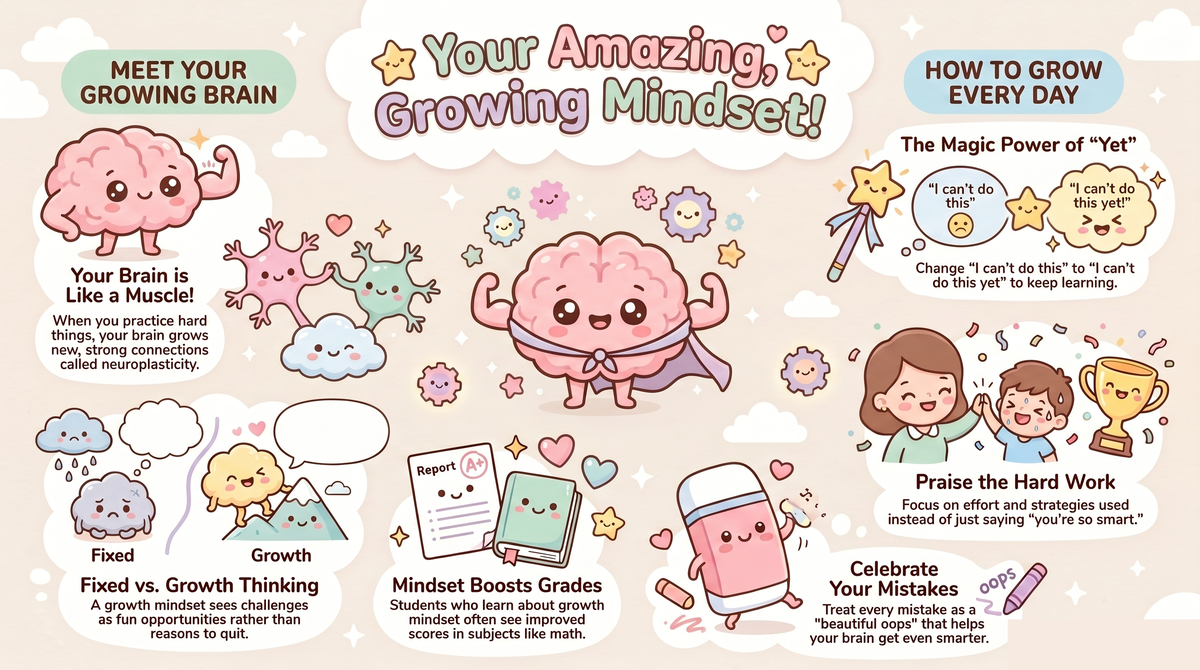
Did you know that when you struggle with a new task, your brain actually gets a tiny bit bigger? It’s true! Specifically, the gray matter in your brain, which is packed with brain cells and their connections, can increase in thickness. This isn't like growing taller; it's more like your brain building new superhighways for information to travel faster and more efficiently.
1. Your Brain: A Muscle for Learning
Think of your brain like a muscle. When you lift weights, your muscles get stronger. When you learn new things, your brain gets stronger too! This idea is called a growth mindset. It means believing that your abilities and intelligence aren't fixed, but can be developed through dedication and hard work.
Imagine you’re trying to learn to ride a bike. At first, it’s wobbly. You might fall over a few times. Your brain cells are working hard to figure out balance, steering, and pedaling all at once. Each wobble, each little correction, and even each tumble sends signals through your brain. These signals tell your brain, "Hey, this is tricky! Let’s build better pathways for this!" This practice strengthens the connections between your neurons, making it easier to balance and ride smoothly next time.
Fun Fact: Studies have shown that the brain areas involved in learning and memory, like the hippocampus, can actually grow in size with new learning experiences!
2. Mistakes: Your Brain’s “Upgrade Complete!” Signal
That feeling of frustration when you can’t quite get something right? That tight chest, the urge to give up? That’s actually your brain sending you a signal that it’s working hard! When you encounter a challenge you can't immediately solve, your brain doesn’t just shut down. Instead, it activates specific areas that signal, "This is hard! Let's try a new approach!"
When you make a mistake, your brain doesn't just register that you failed. It registers that you tried and encountered an obstacle. This is a crucial moment for learning. Neuroscientists have observed that when people make errors, there’s a surge of brain activity, particularly in areas that help us monitor our behavior and adjust our actions. It’s like your brain is saying, “Okay, that didn’t work. Let’s analyze why and try something different next time.”
Think about learning to play a musical instrument. Hitting a wrong note isn't just a sound mistake; it's a signal to your brain that the finger placement or the breath control needs adjustment. Each wrong note, when reflected upon, helps you refine your technique.
Try This at Home: The next time you or your child are struggling with a puzzle, a game, or even a tricky homework problem, pause and acknowledge the feeling. Instead of saying "I can't do this," try saying, "This is challenging, and my brain is working hard to figure it out!" You could even draw a little "brain upgrade" sticker or symbol to put on the page or next to the puzzle when you hit a tough spot.
3. The Power of “Yet”
A key part of the growth mindset is adding the word "yet" to the end of statements like "I can't do this." So, instead of "I can't do math," it becomes "I can't do math yet." This simple addition shifts your perspective from a fixed limitation to a temporary challenge. It implies that with more effort, practice, or a different strategy, you will be able to do it.
This mindset helps children (and adults!) persevere through difficulties. When a child believes their abilities are fixed, they might avoid challenges that could reveal their perceived weaknesses. But with a growth mindset, challenges are seen as opportunities to learn and grow.
Consider learning to read. For some, words flow easily. For others, it’s a slow, painstaking process. A child who thinks, "I'm just not good at reading," might give up. But a child who thinks, "Reading is hard for me yet," understands that continued practice and effort will lead to improvement. They are more likely to ask for help, reread passages, and celebrate small victories, all of which contribute to brain growth in reading skills.
Fun Fact: Children who are praised for their effort and strategies, rather than just their intelligence, are more likely to develop a growth mindset. For example, saying "You worked so hard on that drawing!" is more effective than "You're such a talented artist!"
4. Building Resilience: Bouncing Back Stronger
Mistakes are inevitable parts of learning. Someone with a growth mindset doesn't see mistakes as failures, but as feedback. This feedback is incredibly valuable because it tells us what didn't work, so we can try something else. This ability to learn from setbacks and keep going is called resilience.
When you learn to bounce back from mistakes, you become more confident in tackling new and difficult tasks. You understand that the path to mastery isn't a straight line; it's full of twists, turns, and the occasional stumble. Each time you get back up, you're not just trying the same thing again; you're often trying it with new knowledge gained from the previous attempt.
Think about a scientist in a lab. They might conduct hundreds of experiments that don't yield the expected results. Each "failed" experiment isn't a waste; it provides data that helps them refine their hypotheses and design better experiments for the future. They are building resilience through scientific inquiry.
5. Embracing the Learning Adventure
The journey of learning is far more rewarding when we embrace challenges and see mistakes as stepping stones. By cultivating a growth mindset, we empower ourselves and our children to approach learning with curiosity and courage. We understand that our brains are constantly capable of growth, and that every effort, every attempt, and yes, even every mistake, contributes to building a stronger, more capable mind.
So, the next time you or your child encounter something difficult, remember that feeling of struggle is a sign of your brain working hard, upgrading itself, and building those vital connections. It’s not a sign to quit, but an invitation to keep going, to learn, and to grow.
Frequently Asked Questions (FAQ)
Q: Is it true that my brain physically grows when I learn something new? A: Yes, in a way! When you learn new things and face challenges, the gray matter in your brain, which contains nerve cells and their connections, can actually increase in thickness. It’s like your brain is building more roads for information to travel on.
Q: Should I avoid making mistakes to protect my child’s self-esteem? A: Not at all! Mistakes are essential for learning. Instead of trying to avoid them, help your child understand that making mistakes is a normal and valuable part of the learning process. Focus on praising their effort and how they learn from their mistakes, rather than just the outcome.
Q: What’s the difference between a fixed mindset and a growth mindset? A: Someone with a fixed mindset believes their intelligence and abilities are set and can’t be changed. They might avoid challenges to avoid looking “unsmart.” Someone with a growth mindset believes their abilities can be developed through dedication, practice, and learning from mistakes. They see challenges as opportunities to get better.
Q: How can I encourage a growth mindset in my child? A: Praise their effort, strategies, and perseverance, not just their natural talent. Encourage them to try new things, even if they might struggle. Help them see challenges as opportunities to learn and remind them that it’s okay to make mistakes. Using phrases like "You can’t do it yet" can be very helpful.
Q: What happens in my brain when I make a mistake? A: When you make a mistake, your brain becomes more active, especially in areas that help you monitor your actions and learn from errors. It’s like your brain sends a signal saying, "Okay, that didn't work. Let's figure out why and try a different approach next time!"
Turn this into action, a hands-on, printable mission made for this episode.
The Ranger Field Mission
Run this after every episode to turn listening into something your child actually keeps. Do as many steps as they have energy for — even one counts.
- 1
Say it back
Before snacks or screens, ask your Ranger to teach you the one big idea — as if you'd never heard it.
- 2
Find it in the wild
Hunt for one real example of today's idea — in the kitchen, the yard, the sky, or the sidewalk. Point at it and name it.
- 3
Make something
Draw it, build it from what's on the table, act it out, or record a 20-second “Ranger report.” Making it forces real understanding.
- 4
Ask the next question
Finish with “What's one thing the episode didn't answer?” Stick it on the fridge — that's the start of the next adventure.
This article is part of Parenting With Purpose - free tools and companion guides that turn everyday moments into real learning. Explore the Discovery Rangers podcast kits, browse The Library, or build a calm weekly rhythm with The Sunday Plan.


