AI Tutors vs Nature: The Best Way to Learn?
Watch this episode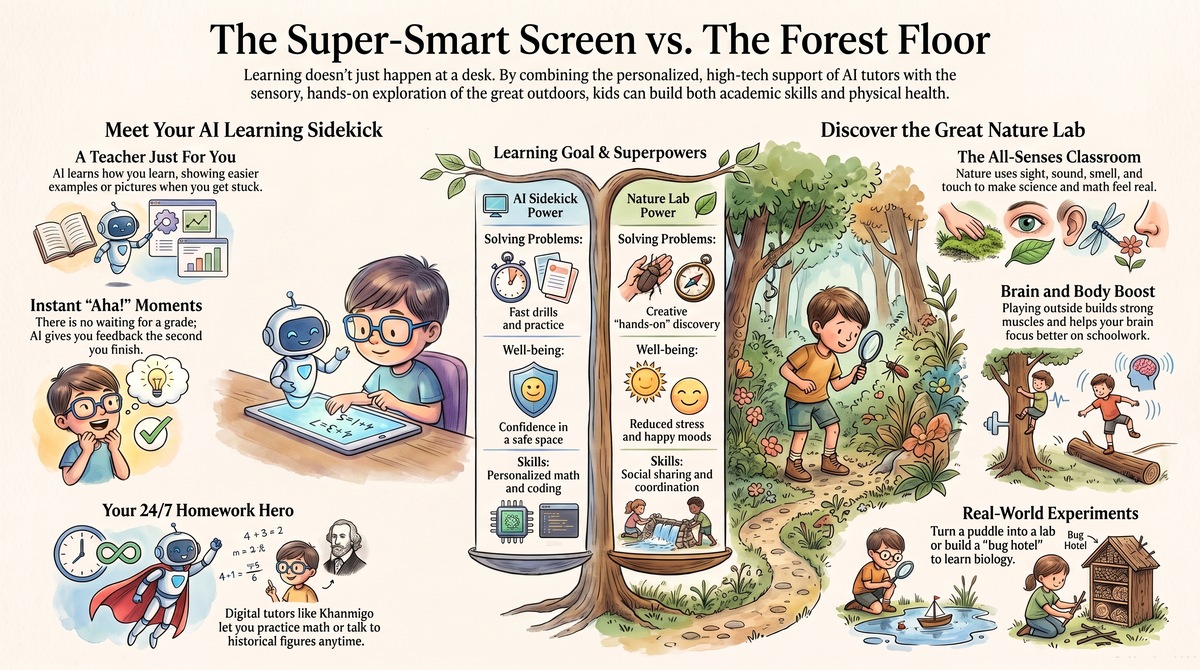
Did you know that Thomas Edison tried thousands of times to invent a working light bulb? When asked about all his "failures," he famously said he didn't fail; he just found thousands of ways that didn't work. That’s a fantastic example of what we’re talking about today: mistakes aren’t roadblocks, they're launchpads for learning!
1. Mistakes Are Your Brain's Superfood
Imagine your brain is like a muscle. The more you use it, the stronger it gets. But how does it get stronger? By tackling challenges! When you try something new, and it doesn’t go quite right, maybe your block tower tumbles down, or your drawing doesn’t look like you pictured, that’s not a sign of defeat. It’s your brain getting a workout! Every time you encounter a problem, figure out what went wrong, and try again, you’re actually building new connections between your brain cells. These connections are like super-highways for information, making you a better thinker and problem-solver.
Fun Fact: Your brain has billions of tiny cells called neurons. When you learn something new or work through a mistake, these neurons create new pathways, essentially upgrading your brain's processing power, much like adding more wires to a super-fast computer!
2. Bouncing Back Like a "Resilience Ranger"
Life isn't always smooth sailing. Sometimes, things get tough. That’s where resilience comes in. Resilience is your superpower for bouncing back after something doesn’t go your way. Think about babies learning to walk. They stumble, they fall, they might even cry a little, but they don’t stay down. They get back up and try again, fueled by an amazing inner drive. That’s resilience in action! Cultivating resilience means understanding that setbacks are temporary and that you have the strength to keep going.
3. The "Growth Mindset" Magic
There are two main ways people think about their abilities. One is a "fixed mindset," where you believe your talents and intelligence are set in stone, you're either good at something or you're not. The other is a "growth mindset." This is the belief that you can develop your abilities through dedication, hard work, and learning from your experiences. Someone with a growth mindset sees challenges not as threats, but as opportunities to learn and grow. They understand that effort is the path to mastery, and that even difficult tasks can be accomplished with persistence.
Fun Fact: Even in nature, "mistakes" can lead to incredible discoveries. Scientists studying how plants grow might try different watering schedules or light exposures. If a plant doesn't thrive under certain conditions, that "mistake" teaches the scientist valuable information about what the plant truly needs to flourish.
4. AI Tutors vs. The Wild World of Learning
We live in an amazing time where AI tutors can offer personalized lessons, instant feedback, and endless practice. They can be incredibly helpful tools for drilling facts or practicing specific skills. But can an AI truly replicate the messy, beautiful, and deeply human process of learning from mistakes? AI can be programmed to learn and adapt, but it doesn't experience the frustration of a failed attempt, the quiet determination to try again, or the triumphant "aha!" moment of figuring something out after many tries. Nature, on the other hand, is the ultimate teacher of resilience and adaptation. Observing how animals survive, how plants grow, and how ecosystems evolve shows us that learning, trial, and error are fundamental to progress.
5. Putting Learning into Practice
How do we actually practice building resilience and a growth mindset? It's all about hands-on experience.
Try This at Home: The "Mistake Experiment"
- Building Challenge: Grab some blocks and challenge yourselves to build the tallest tower possible. What happens when it inevitably topples? Talk about why it fell. Was the base too narrow? Were the blocks uneven? Use what you learned to build an even stronger tower next time.
- Drawing Challenge: Pick a favorite animal and try to draw it. If it doesn't look exactly like you imagined, don't crumple it up! What details could you add to make it more vibrant? Maybe you can add a colorful background or some fun textures.
- Baking Together: Find a simple recipe, like cookies or muffins, and follow the steps. If the final result isn't quite perfect, maybe a little burnt or a bit too crumbly, that’s okay! What can you learn for the next baking adventure? Did you bake it too long? Too much flour?
These activities show that learning is a journey with ups and downs, and every step, even the wobbly ones, brings you closer to success.
Frequently Asked Questions (FAQ)
Q: My child gets really upset when they make a mistake. How can I help them develop a growth mindset? A: Start by normalizing mistakes. Share your own experiences with making errors and what you learned. When your child makes a mistake, focus on the effort they put in and what they can try differently next time, rather than just the outcome. Phrases like "That was a tricky part, what could we try next?" or "I see how hard you worked on that!" can be very encouraging.
Q: Is it ever okay for my child to give up on something difficult? A: It's important to distinguish between giving up and knowing when to pivot or take a break. If something is causing genuine distress or is developmentally inappropriate,
The Ranger Field Mission
Run this after every episode to turn listening into something your child actually keeps. Do as many steps as they have energy for — even one counts.
- 1
Say it back
Before snacks or screens, ask your Ranger to teach you the one big idea — as if you'd never heard it.
- 2
Find it in the wild
Hunt for one real example of today's idea — in the kitchen, the yard, the sky, or the sidewalk. Point at it and name it.
- 3
Make something
Draw it, build it from what's on the table, act it out, or record a 20-second “Ranger report.” Making it forces real understanding.
- 4
Ask the next question
Finish with “What's one thing the episode didn't answer?” Stick it on the fridge — that's the start of the next adventure.
This article is part of Parenting With Purpose - free tools and companion guides that turn everyday moments into real learning. Explore the Discovery Rangers podcast kits, browse The Library, or build a calm weekly rhythm with The Sunday Plan.