What Did Dinosaurs Eat? Uncovering Ancient Fossil Feasts
1. A T. Rex's Last Meal Found in Its Belly!
Imagine finding a dinosaur fossil. Now imagine finding a piece of another dinosaur's bone stuck inside its stomach! That's exactly what scientists discovered in a Tyrannosaurus rex fossil. This amazing find tells us T. rex wasn't just a scary predator; it was a real-life dinosaur diner, munching on other dinosaurs.
2. Digging Up Dinner Clues
How do scientists know what ancient creatures, like dinosaurs, munched on millions of years ago? It's like being a detective, but instead of fingerprints, they look for fossilized clues. These clues are hidden in a few surprising places.
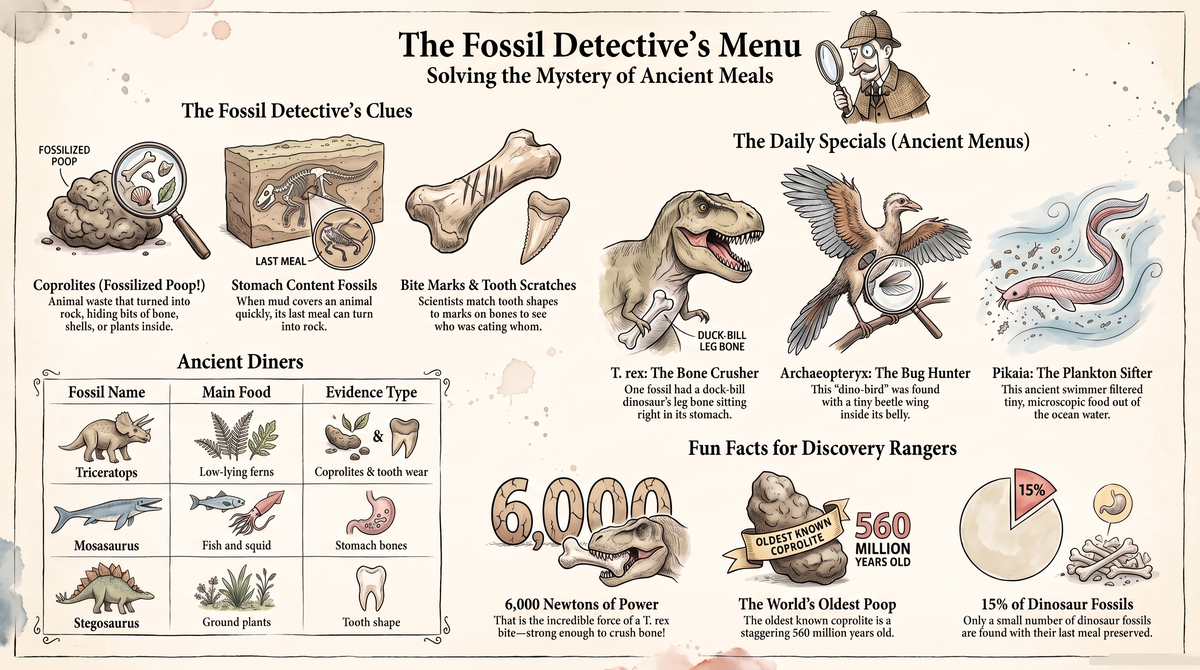
One major clue is what's left inside an animal's stomach when it died. If the animal was buried quickly by mud or sand, its stomach and the food inside could turn into rock over a very long time. This is called fossilized stomach content. It’s like finding a fossilized fast-food wrapper!
Another clue comes from teeth. Sharp teeth leave marks on bones they bite. Scientists can compare these marks to dinosaur teeth to figure out who was doing the chomping. It’s like matching a bite to a specific cookie cutter.
And then there's the most surprising clue of all: fossilized poop! Yes, ancient animal waste can become rock, and these rocks are called coprolites. Inside a coprolite, scientists can find bits of bones, shells, or plant fibers. This tells them exactly what went in one end and what came out the other. It’s a direct look at their last meals.
Fun Fact: About 15% of all dinosaur fossils show signs of preserved stomach contents! That means a good number of them have left behind a record of their last meal.
3. What's on the Ancient Menu?
Let's look at some famous ancient eaters and what scientists have learned they gobbled up.
Dinosaur Dinners
Tyrannosaurus rex: This giant meat-eater lived about 68 million years ago. We know it ate other dinosaurs, like duck-billed hadrosaurs, because scientists found hadrosaur bone fragments in a T. rex's fossilized stomach. T. rex had incredibly powerful jaws, strong enough to crush bone! A T. rex tooth could bite with a force of 6,000 Newtons - that’s like having the weight of a small car pressing down!
Triceratops: Unlike T. rex, Triceratops was a plant-eater, living around 66 million years ago. Its teeth were perfect for grinding tough plants. Fossilized poop (coprolites) from the same time and place as Triceratops fossils often contain plant fibers and pollen. This tells us they munched on low-growing plants like ferns and early flowering plants.
Stegosaurus: This dinosaur, with the famous plates on its back, lived about 155 million years ago. Scientists think Stegosaurus ate low-lying plants, like ferns. Its teeth weren't built for tearing meat but for chewing.
Marine Reptile Meals
- Mosasaurus: Imagine a giant sea lizard that lived about 70 million years ago. Mosasaurs were powerful predators in the ancient oceans. Fossilized poop from a Mosasaurus found in Belgium contained fish scales, shark teeth, and squid hooks! This shows they ate a variety of seafood, including fish and squid, and sometimes even smaller marine reptiles. They likely swallowed their prey whole.
Early Birds and Tiny Eaters
- Archaeopteryx: This creature, which lived about 150 million years ago, is a fascinating link between dinosaurs and birds. A fossil of Archaeopteryx was found with a tiny insect wing preserved inside its stomach. This tells us this early "dinobird" snacked on insects like beetles and moths.
Very Ancient Filter-Feeders
- Pikaia: Way back in the Cambrian period, over 500 million years ago, lived a small, worm-like creature called Pikaia. Scientists studied special chemical traces in its fossilized gut. These traces showed it ate very fine particles. Pikaia was a filter-feeder, meaning it sifted tiny bits of food, like plankton, right out of the water.
Fun Fact: The oldest known coprolite (fossilized poop) is about 560 million years old! That's a lot of ancient droppings to study.
4. Try This at Home: Fossil Detective
You can be a fossil detective too! Grab some playdough or modeling clay. Use different objects (like a toy dinosaur tooth, a twig, or a pebble) to make "bite marks" or "imprints" in the clay. What do the marks tell you about the object that made them? You can also press small leaves or bits of yarn into the clay to represent stomach contents or coprolites.
5. How Diets Changed Over Time
The food animals ate has changed a lot over millions of years.
- Cambrian Period (over 500 Myr ago): Life was mostly tiny. Creatures like Pikaia filtered small bits from the water.
- Permian Period (about 250-299 Myr ago): Larger animals appeared. Some ate plants, and others ate smaller creatures.
- Mesozoic Era (about 66-252 Myr ago): This was the Age of Dinosaurs! There were giant plant-eaters and fearsome meat-eaters, all sharing the land and seas.
- Cenozoic Era (from 66 Myr ago to today): After the dinosaurs, mammals became bigger and more diverse. Animals like early horses munched on grasses, and early whales hunted fish.
These changes happened because Earth's climate and the plants on land and in the sea were constantly changing. As the environment changed, so did the food available, and animals adapted to eat new things.
6. Why Does This Matter?
Knowing what ancient animals ate is super important for scientists.
- Understanding Ecosystems: It helps us figure out how ancient food webs worked. Who was hunting whom? Who was being eaten? This shows us how ancient environments functioned.
- Learning About Extinctions: If an animal's main food source disappeared, it could have led to that animal going extinct. Studying diets helps us understand why some species vanished.
- Connecting to Today: Learning about ancient diets helps us understand modern animal nutrition and how to protect animals living today.
Frequently Asked Questions (FAQ)
Q: How do scientists know if a dinosaur was a meat-eater or a plant-eater? A: They look at the dinosaur's teeth. Sharp, pointy teeth are good for tearing meat, while flat, broad teeth are better for grinding plants. They also study fossilized stomach contents and coprolites (fossilized poop) for clues.
Q: Can scientists find everything an animal ate? A: Not always. Fossils are rare, and not all stomach contents or coprolites survive the millions of years to become fossils. But scientists can piece together a good idea of their main foods.
Q: Did all dinosaurs eat other dinosaurs? A: No! Many dinosaurs were herbivores, meaning they ate plants. Think of Triceratops and Stegosaurus. Only some dinosaurs, like T. rex, were carnivores that ate meat.
Q: What’s the weirdest thing found in a fossilized stomach or coprolite? A: Scientists have found all sorts of things! In coprolites, they've found fish scales, squid beaks, and even shark teeth. In fossilized stomachs, they've found bones, shells, and insect parts.
Q: Are coprolites the only way to know what ancient animals pooped? A: Yes, coprolites are fossilized poop, so they are the only way we can study the waste of animals that lived millions of years ago. It’s a very unique and helpful kind of fossil!
Episode quiz
Try each question on your own, then tap Show Answer to check yourself.
Question 1
What did scientists find inside a T. rex fossil that showed it ate other dinosaurs?
- A.A piece of another dinosaur's bone
- B.Fossilized leaves
- C.An ancient bird feather
Question 2
What is fossilized poop called?
- A.Coprolite
- B.Gastrolith
- C.Amber
Question 3
What did scientists learn about Triceratops's diet from its coprolites?
- A.It ate tough plants like ferns.
- B.It ate fish and squid.
- C.It ate insects.
Question 4
What did a fossilized Mosasaurus poop contain?
- A.Fish scales, shark teeth, and squid hooks
- B.Plant matter and pollen
- C.Insect wings
Question 5
What did a fossil of Archaeopteryx have preserved inside its stomach?
- A.A tiny insect wing
- B.A small fish bone
- C.Plant seeds
Flashcards
Read the prompt, then tap Show Answer when you are ready.
What did scientists find inside a T. rex fossil?
How do scientists learn what dinosaurs ate?
What is fossilized stomach content?
What are coprolites?
What did T. rex eat?
What did Triceratops eat?
What did Stegosaurus eat?
What did Mosasaurus eat?
What did Archaeopteryx eat?
What is Pikaia?
What is the oldest known coprolite?
What was the Cambrian Period like for food?
The Ranger Field Mission
Run this after every episode to turn listening into something your child actually keeps. Do as many steps as they have energy for — even one counts.
- 1
Say it back
Before snacks or screens, ask your Ranger to teach you the one big idea — as if you'd never heard it.
- 2
Find it in the wild
Hunt for one real example of today's idea — in the kitchen, the yard, the sky, or the sidewalk. Point at it and name it.
- 3
Make something
Draw it, build it from what's on the table, act it out, or record a 20-second “Ranger report.” Making it forces real understanding.
- 4
Ask the next question
Finish with “What's one thing the episode didn't answer?” Stick it on the fridge — that's the start of the next adventure.
This article is part of Parenting With Purpose - free tools and companion guides that turn everyday moments into real learning. Explore the Discovery Rangers podcast kits, browse The Library, or build a calm weekly rhythm with The Sunday Plan.


