The Invisible Hand: How Trade Helps Everyone
Watch this episode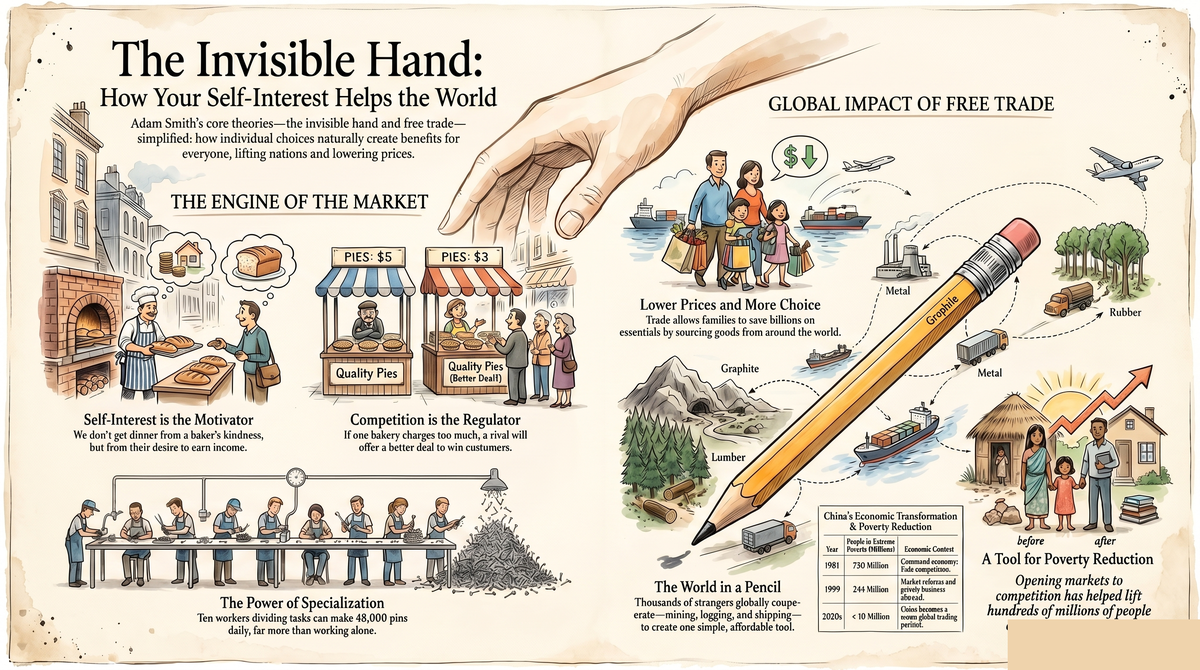
1. Introduction: The Playground Economy
Have you ever watched your child trade a holographic sticker for a specific snack, or swap a toy car for a glow-in-the-dark pen? In those moments, you are witnessing a tiny, vibrant version of the global economy. Both children wanted something the other had, and through a simple exchange, both walked away happier.
This act of trading is the foundation of a big idea discovered by a philosopher named Adam Smith in the 1700s. Smith realized that these small trades, multiplied by billions of people, actually help the whole world grow. He used a warm and accessible metaphor called the "Invisible Hand" to describe how people working together, even when they don't know each other, makes life better for everyone.
As a parent, you can use these concepts to turn every grocery run or toy-room cleanup into a lesson on global teamwork. This guide will help you explain how the "magic" of the market is actually the result of people helping themselves by being helpful to others.
2. Who Was Adam Smith? (The Man Behind the Idea)
Adam Smith (1723-1790) was a Scottish philosopher often called the "father of modern economics." He didn't just care about money; he cared about how people get along. He shared his observations in two major books:
- The Theory of Moral Sentiments (1759): This is where he first mentioned the "Invisible Hand." He described a wealthy landlord who owned massive fields. Although the landlord was selfish, his stomach wasn't big enough to eat all the food his land produced! To get his house built and his clothes made, he had to share his extra food with the people who worked for him. Without meaning to, his self-interest ended up feeding many families.
- The Wealth of Nations (1776): In his most famous work, Smith explained that a shopkeeper doesn't start a business just to be a hero; they do it to support their own family. However, to earn that money, they must provide goods that neighbors need. By looking out for their own family, they accidentally create jobs and wealth for the whole community.
3. The Two Superheroes of Trade: Self-Interest and Competition
To help your child understand how the market moves, introduce them to the two "superheroes" that guide the Invisible Hand.
Self-Interest (The Motivator) It is important to distinguish self-interest from "greed." Self-interest means doing something because you want a good result for yourself. As Smith famously wrote, we don't expect our dinner because the baker is being "kind," but because the baker wants to earn money for their family.
- The Lemonade Stand Example: Imagine your child opens a lemonade stand to buy a new video game. Because they want that game (self-interest), they work hard to make the lemonade cold and tasty. They are friendly to neighbors because it helps them reach their goal. The neighbors get a great drink, and your child gets their game, everyone wins.
Competition (The Regulator & Innovator) If self-interest is the engine, competition is the steering wheel. It keeps things fair and pushes us to be better.
- The Two Bakeries Scenario: If Bakery A charges $10 for bread, Bakery B might charge $5 to get more customers. Bakery A then has to lower their price or make even better, tastier bread.
- Innovation: Competition doesn't just lower prices; it’s the reason we have cooler, faster toys and better technology. If one toy company makes a tablet, another company will try to make one that is even faster or has better games to win your choice.
4. Why Free Trade is a Global Win
When the Invisible Hand works across borders, we call it Free Trade. This means countries can swap goods without extra "penalty taxes" called tariffs.
The Five Major Benefits of Free Trade:
- 💰 Lower Prices & More Choices: Global competition saves families money. In 2014, American families saved an estimated $13 billion on clothes and electronics because of trade.
- 🚀 Better Jobs: Trade supports 12 million U.S. jobs linked to exports. These jobs often pay 13-16% higher wages than non-trade jobs.
- 📈 Helping Poor Countries: Trade allows people in developing nations to sell their goods globally, raising their living standards and lifting millions out of poverty.
- 💡 Spreading Ideas: Trade spreads "brain power." When we trade for solar panels from Germany or technology from Japan, we learn how to make things better at home.
- 🕊 Promoting Peace: When countries depend on each other for goods, they are less likely to fight. The European Union is a great example of how trade helped prevent war in a region once known for conflict.
5. The Incredible Journey of a T-Shirt (and a Pin Factory)
To show your child how the Invisible Hand works, trace the path of a T-shirt. It uses cotton from India, is turned into fabric in Vietnam, and sold in the U.S. No "World Director" planned this; it happened because everyone involved wanted to do their part of the job well.
Teamwork through Specialization Adam Smith explained why this is so fast and cheap through his Pin Factory story. He noticed that:
- One person working alone might only make 20 pins a day.
- But when 10 people work together, each specializing in one small step (one draws the wire, one cuts it, one flattens the head), they can make 48,000 pins a day!
This is called Specialization. It’s why your T-shirt doesn't cost $100. It’s also the secret behind the "I, Pencil" concept: thousands of people from Sri Lanka (graphite) to Peru (metal) cooperate to make a 10-cent tool that no single person on Earth could make alone.
6. Real-World Impact: The Story of China’s Growth
The most compelling evidence of the Invisible Hand in action is China. By opening its markets to competition rather than relying on foreign aid, China achieved the largest poverty reduction in history.
The Power of Opening Markets
| Period/Year | What Happened | Result (People in Poverty) |
|---|---|---|
| 1981 | Command economy (government-run). No private business freedom. | 730 Million in extreme poverty. |
| 1980s-1990s | Market reforms began. Farmers could sell extra food; private businesses allowed. | Poverty plummeted; rural incomes doubled in 10 years. |
| 2008 | China became a "global factory" through international trade. | 97 Million in extreme poverty. |
| 2020s | China transitions to a middle-income country. | < 10 Million in extreme poverty. |
7. Teaching Moments: When the Hand Needs Help
While the Invisible Hand is powerful, it isn't magic. Sometimes the "Hand" needs a "Referee" to keep the game fair.
- Monopolies: If there is only one pencil factory, they can charge too much. We need more than one player to keep prices fair.
- Externalities (The Polluted River): A factory might dump trash in a river to save money. This helps their profit but hurts the community.
- The Fishing Pond (Tragedy of the Commons): If everyone is free to catch as many fish as they want in a shared pond without rules, soon there will be no fish left for anyone.
- Fairness: The "economic pie" gets bigger with trade, but it isn't always sliced equally.
In these cases, the Government acts as a "Fair Referee." Adam Smith believed the government should:
- 🏫 Build schools, roads, and bridges.
- 🛡 Enforce rules against cheating, theft, and pollution.
- 🤝 Protect the country and help those unable to work.
8. Conclusion: Kitchen Table Conversation Starters
Trade is simply a form of giant, invisible teamwork. To help your child see this "magic" in their own life, try these simple activities:
- The "Made In" Scavenger Hunt: Next time you’re at the grocery store or in the toy room, find five items from five different countries. Ask: "How many people do you think worked together to get this to our house?"
- The Specialized Sandwich: Try making lunch together like a "Pin Factory." One person spreads the peanut butter, one adds the jelly, one cuts the crust. See how much faster it is when you specialize!
- The Fair Trade Question: Next time your child wants to trade a toy or a snack, ask: "How do we make sure both of you feel like you won this trade?"
- The Innovation Talk: Look at an old toy vs, a new one. Ask: "How did competition help make this newer toy better or more fun?"
9. FAQ: Frequently Asked Questions for Parents
Is teaching self-interest the same as teaching my child to be selfish? Not at all. In a market, the only way to satisfy your self-interest is to figure out what other people want and need. It teaches children that to reach their own goals, they must be helpful and productive members of society.
How can I explain "tariffs" if my child asks about the news? Tell them a tariff is like a "penalty tax" on a toy from another country. It makes that toy more expensive so people might buy a local toy instead. While it might help the local toy maker, it means your family has less money left over for other things.
Did Adam Smith worry about anything? Yes! Even Smith and other thinkers like Noam Chomsky pointed out that while global trade is great, it is also important to care for our own "home team." Smith understood that people naturally feel a desire to support their own communities and that the Invisible Hand works best when we follow the rules of fairness.
Why should my child care where their toys are made? It helps them realize they are part of a global community. Understanding that a simple toy required the cooperation of people in India, Vietnam, and the U.S. encourages them to see the world as a place of teamwork rather than just a place of strangers.
Turn this into action, a hands-on, printable mission made for this episode.
The Ranger Field Mission
Run this after every episode to turn listening into something your child actually keeps. Do as many steps as they have energy for — even one counts.
- 1
Say it back
Before snacks or screens, ask your Ranger to teach you the one big idea — as if you'd never heard it.
- 2
Find it in the wild
Hunt for one real example of today's idea — in the kitchen, the yard, the sky, or the sidewalk. Point at it and name it.
- 3
Make something
Draw it, build it from what's on the table, act it out, or record a 20-second “Ranger report.” Making it forces real understanding.
- 4
Ask the next question
Finish with “What's one thing the episode didn't answer?” Stick it on the fridge — that's the start of the next adventure.
This article is part of Parenting With Purpose - free tools and companion guides that turn everyday moments into real learning. Explore the Discovery Rangers podcast kits, browse The Library, or build a calm weekly rhythm with The Sunday Plan.