
Grow Your Brain Power: Learning from Mistakes
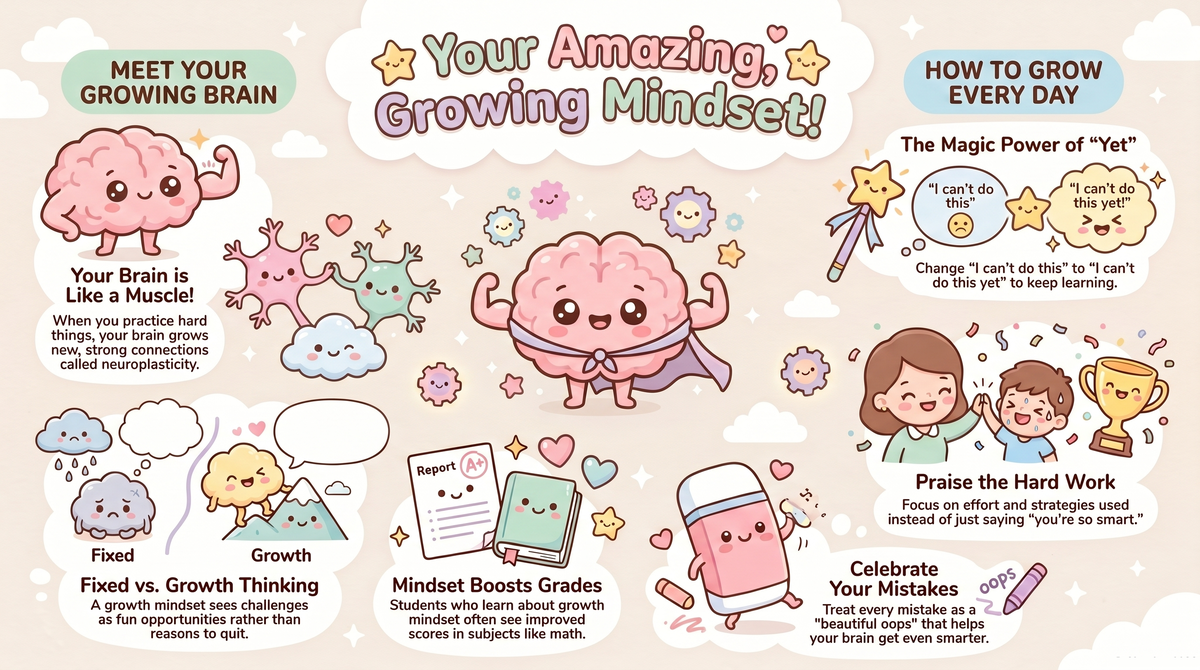
Every time you mess up and try again, your brain physically rewires itself. building new connections and getting stronger. That toppled Lego tower and that impossible math problem? They’re brain workouts. This week on the Discovery Rangers podcast, we’re taking a close look at the science of how our brains learn, and why mistakes are the secret superpower for building a sharper, stronger mind.
1. Your Brain: A Muscle That Grows Stronger
Imagine your child's brain not as a fixed, unchangeable entity, but as a powerful muscle. Just like a bicep gets stronger with exercise, our brains get stronger and more capable with every new challenge and every attempt to learn something difficult. This is the core idea behind what scientists call the "growth mindset."
When we encounter something new or challenging, our brain creates new connections between its nerve cells, called neurons. Think of these connections like tiny pathways. The more we use a particular pathway, for example, by practicing a new skill like riding a bike or solving a math problem, the stronger and more efficient that pathway becomes. It’s like paving a dirt path into a superhighway! This process of building and strengthening neural connections is how our brains physically change and grow.
Fun Fact: The average human brain contains about 86 billion neurons! That's more than the number of stars in our Milky Way galaxy!
2. The "Stuck" Feeling: Your Brain's Upgrade Signal
Have you ever noticed that frustrated sigh, the furrowed brow, or the feeling of wanting to give up when something is just hard? That physical and emotional sensation of being stuck is actually a sign that your brain is working overtime! Instead of being a signal to quit, it's your brain's way of telling you, "Hey, this is challenging, and I'm working hard to figure it out!"
When we push through that feeling of difficulty, our brains are actively forming those new neural connections we talked about. This is the biological sensation of your brain "upgrading its hardware." It's not about being perfect or never making mistakes; it's about the process of learning and the adventure of tackling something that stretches your abilities. The "aha!" moment when a difficult concept finally clicks is incredibly rewarding, and it's built on a foundation of those earlier struggles.
3. Embracing Mistakes: The Superpower of Learning
For a long time, we've been taught to avoid mistakes at all costs. But the science is clear: mistakes aren't failures; they are essential stepping stones in the learning process. When we make a mistake, our brain gets valuable feedback. It tells us what didn't work, prompting us to try a different approach.
Think about it: if you touch a hot stove and get burned, you immediately learn that touching it is a bad idea. Your brain registers that information, and you're much less likely to do it again. Learning from mistakes in less obvious situations works the same way. When a math problem is solved incorrectly, the mistake highlights a gap in understanding that can then be addressed and filled. When a drawing doesn't turn out as planned, examining what went wrong can lead to learning new techniques.
The key is to shift our perspective. Instead of saying, "I'm bad at this," we can encourage our children to think, "This is hard, but I can learn from what didn't work and try again." This shift fosters resilience and a love for the learning journey.
Fun Fact: Studies have shown that the brain actually lights up more intensely in the areas associated with learning and problem-solving when we are confronted with a mistake than when we get something right the first time!
4. The Growth Mindset in Action
A growth mindset, first popularized by psychologist Dr. Carol Dweck, is the belief that our abilities and intelligence can be developed through dedication and hard work. People with a growth mindset see challenges as opportunities, learn from criticism, and are inspired by the success of others. They understand that effort is the path to mastery.
In contrast, a "fixed mindset" is the belief that our qualities are fixed traits. People with a fixed mindset tend to avoid challenges, give up easily when faced with obstacles, and feel threatened by the success of others. They might believe that if they aren't naturally good at something, they never will be.
For our kids, nurturing a growth mindset means praising their effort and strategies, not just their innate talent. When they achieve something, we can say, "Wow, you worked really hard on that problem, and your persistence paid off!" or "I love how you tried different ways to solve that puzzle!" This reinforces the idea that their effort and strategic thinking are what lead to success.
Try This at Home: The next time your child is struggling with a task, whether it's building with blocks, learning a new game, or tackling homework, encourage a "Mistake Detective" activity. Ask them:
- "What happened here?"
- "What did you learn from that?"
- "What could you try differently next time?" Focus on the learning process and the insights gained, rather than the "error" itself.
5. Building Resilience Through Learning
Resilience is the ability to bounce back from setbacks and challenges. It's a crucial skill for navigating life's ups and downs, and learning from mistakes is a powerful way to build it. When children are encouraged to view mistakes as learning opportunities, they develop a stronger sense of self-efficacy, the belief in their own ability to succeed.
Each time they face a difficulty, try a new strategy, and perhaps even make another mistake before finally succeeding, they are building their capacity to persevere. They learn that setbacks are not endpoints but rather temporary detours on the path to mastery. This builds confidence and a willingness to take on new challenges in the future, which is the essence of a truly empowered learner.
Frequently Asked Questions (FAQ)
Q: My child gets so upset when they make a mistake. How can I help them feel better? A: It's completely normal for children to feel frustrated by mistakes. The key is to validate their feelings first ("I can see you're feeling really disappointed right now") and then gently reframe the situation. You can say something like, "Mistakes are how our brains learn. What can we figure out from this?" or "This is a tricky part, and trying again is how we get stronger." Focus on the effort and the learning, not just the outcome.
Q: Is it okay to tell my child they are "smart" or "talented"? A: While well-intentioned, focusing too much on innate qualities like "smart" or "talented" can inadvertently foster a fixed mindset. Instead, try praising their process and effort. Say things like, "You're a great problem-solver!" or "You worked so hard to master that skill!" This highlights the actions and strategies that lead to success, which are things they can control and develop.
Q: How can I help my child understand that learning takes time and effort? A: Use analogies! You can compare their brain to a muscle that needs exercise, or learning to building something brick by brick. Talk about your own learning experiences, including times you've struggled and persevered. Reading books or watching shows about characters who overcome challenges can also be inspiring.
Q: What if my child is actually struggling with a learning disability, and it's not just about mindset? A: This is an important distinction. While a growth mindset is beneficial for all children, it's crucial to recognize when a child might need additional support. If you consistently see significant struggles despite effort and a positive attitude, it's a good idea to speak with your child's teacher or a pediatrician. They can help assess for underlying learning differences and provide appropriate resources and strategies.
Q: How do I balance encouraging learning from mistakes with ensuring they do their best work? A: The goal isn't to encourage carelessness, but to foster a healthy approach to challenges. You can set expectations for effort and attention to detail, but when mistakes happen, approach them as learning opportunities. Encourage them to review their work, identify where things went wrong, and correct them. This teaches them to be diligent and to learn from any errors that occur along the way.
Turn this into action, a hands-on, printable mission made for this episode.
The Ranger Field Mission
Run this after every episode to turn listening into something your child actually keeps. Do as many steps as they have energy for — even one counts.
- 1
Say it back
Before snacks or screens, ask your Ranger to teach you the one big idea — as if you'd never heard it.
- 2
Find it in the wild
Hunt for one real example of today's idea — in the kitchen, the yard, the sky, or the sidewalk. Point at it and name it.
- 3
Make something
Draw it, build it from what's on the table, act it out, or record a 20-second “Ranger report.” Making it forces real understanding.
- 4
Ask the next question
Finish with “What's one thing the episode didn't answer?” Stick it on the fridge — that's the start of the next adventure.
This article is part of Parenting With Purpose - free tools and companion guides that turn everyday moments into real learning. Explore the Discovery Rangers podcast kits, browse The Library, or build a calm weekly rhythm with The Sunday Plan.


