
Free Speech for Kids: James Madison & the First Amendment
1. Introduction: Why Big Ideas Matter for Little Citizens
Have you ever watched your child come home excited to share a "weird" idea they had in class, or witnessed them insist on wearing a specific T-shirt because it represents something they care about? These everyday moments of childhood are actually small-scale exercises in a fundamental American right: free speech.
In the United States, we have a "special right" called the First Amendment. It is more than just a legal rule; it is a core value that protects our ability to speak our minds, even when our words might be unpopular or upsetting to others.
The Big Idea: The First Amendment ensures that the government cannot create laws to stop you from expressing yourself. By protecting all speech, including the "words we dislike", we create a space where everyone can share ideas, solve problems together, and keep our leaders honest. In a free country, the government doesn't get to decide which ideas are "good"; that is our job as citizens.
2. Meet the "Father of the Bill of Rights": James Madison
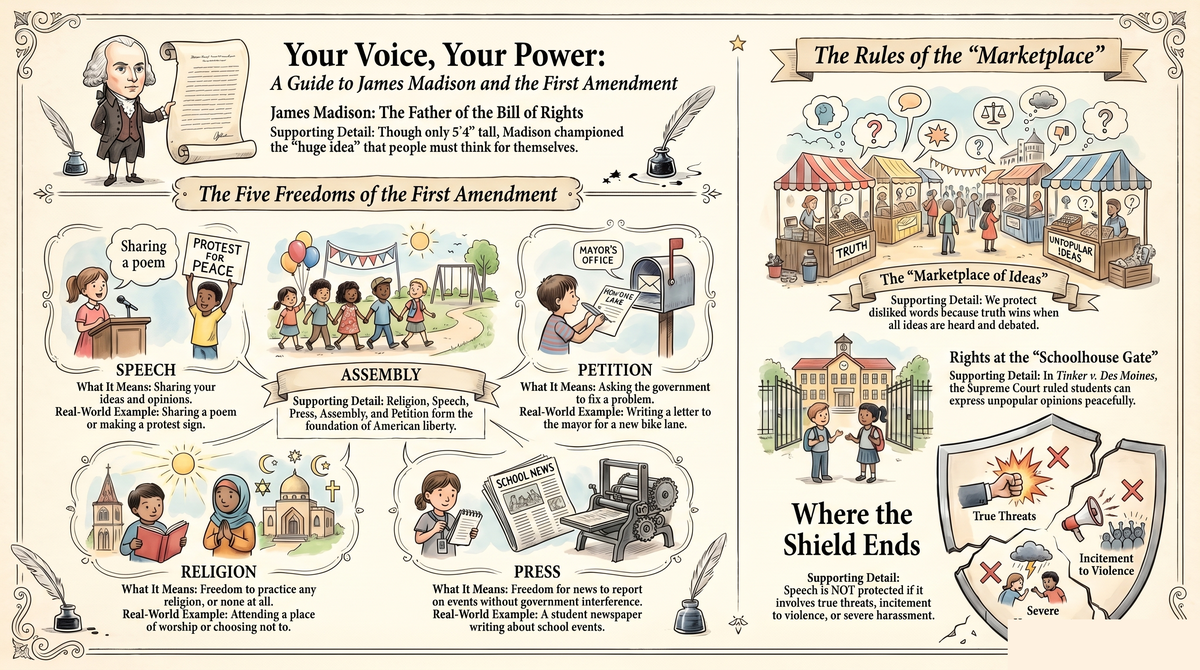
To understand free speech, it helps to know the person who helped define it. James Madison was a central figure in early American history, known as the "Father of the Constitution" and the "Father of the Bill of Rights."
- A Lifelong Advocate: Born in 1751, Madison believed that for a country to be truly free, people must be able to think and speak for themselves.
- A Shield Against Power: He fought for the Bill of Rights, a list of freedoms the government could never take away. He wanted to ensure citizens could criticize the government without fear of punishment.
- Leading by Example: Even as President, when he faced harsh criticism, he defended the right of others to speak freely. He believed that rights and responsibilities go hand-in-hand, a principle that guided his entire life.
Fun Fact: While his ideas were massive, the man himself was quite small, standing only 5 feet, 4 inches tall!
3. Breaking Down the Five Freedoms
Added to the Constitution in 1791, the First Amendment protects five distinct freedoms that allow us to participate in a democracy.
| The Freedom | What it Means (Kid-Friendly) | Real-World Example |
|---|---|---|
| Religion | You can believe what you want, pray how you want, or choose not to follow a religion at all. | Wearing a cross, a hijab, or a yarmulke; or choosing not to wear any religious symbol. |
| Speech | You can say what you think, write your thoughts, and share ideas through words or art. | Sharing an opinion in class, writing a poem, or making a sign about a cause you care about. |
| Press | Reporters, TV, and websites can share news and opinions without the government stopping them. | A school newspaper writing about a new rule, or a kid blogger reviewing a video game. |
| Assembly | You can meet peacefully with others to share ideas or support a cause. | Grouping together with friends for a peaceful walk to ask for a new neighborhood playground. |
| Petition | You can ask the government to fix a problem or change a rule. | Writing a letter to the mayor for a bike lane or starting a petition for longer school recess. |
Note to Parents: These protections specifically limit the government (including public schools and police). Private spaces, such as your home or private social media companies, are allowed to set their own rules for speech.
4. The "Marketplace of Ideas": Why We Protect Unpopular Speech
It can be difficult to explain to a child why we protect mean or unpopular words. However, the First Amendment rests on three vital concepts:
The Marketplace of Ideas
Think of this like a market where shoppers choose the best products. When everyone is allowed to speak, the best and truest ideas rise to the top. This works because the government is not the "decider" of what is right, we, the citizens, are. By letting everyone talk, we can expose lies and reject bad ideas together.
A Safety Valve
Think of free speech as a pressure valve on a steam engine. If people feel they aren't being heard or can't protest peacefully, they might become so frustrated that they turn to violence to get attention. Free speech provides a peaceful way for people to release that "pressure" and be heard, which keeps our communities safer.
Protecting the Minority
The majority of people usually don't need protection because their views are already popular. The First Amendment exists to protect the "minority", those with unpopular views.
The Playground Example: Imagine if every kid on the playground wanted to play tag, but one person wanted to play hide-and-seek. The First Amendment means the "tag majority" can’t use the government to force the "hide-and-seek minority" to be quiet about what they want to play. If the government could silence one person's unpopular view today, it could silence your view tomorrow.
5. Where is the Line? Understanding the Limits of Free Speech
While speech is "free," it is not "unlimited." There are narrow categories where speech causes immediate harm and is not protected.
- True Threats: Saying you will hurt someone right now or very soon.
- Incitement: Trying to get a crowd to break the law or start violence immediately.
- Fighting Words: Face-to-face insults intended to start an immediate physical fight.
- Libel and Slander: Lying on purpose to hurt someone’s reputation.
- Harassment: Severe, repeated, and hurtful speech that makes it impossible for someone to feel safe or to learn.
- Obscenity: Graphic material with no artistic value (this is a category usually handled by courts and intended for older audiences).
Consultant Tip for Parents: When talking to your child, explain that they can say something "mean" (like "I don't like your shoes") and it's protected by the First Amendment, though it's still not kind! However, if they say that every single day to the same person until that person is afraid to come to school, that crosses the line into harassment, which is not protected.
6. Free Speech at School: The Power of Student Voices
The most famous case regarding student speech is Tinker v. Des Moines (1969).
- The Story: In 1965, 13-year-old Mary Beth Tinker and her brother wore black armbands to school to protest the Vietnam War. They were suspended because the school was afraid the armbands would cause trouble.
- The Outcome: The Supreme Court ruled that students do not "shed their constitutional rights... at the schoolhouse gate."
- Parent-to-Kid Translation: This means your rights don't disappear just because you walked through the school doors!
Reasonable Rules for Schools
While schools must respect speech, they can set rules for "Time, Place, and Manner." Use this checklist to see if a school rule is reasonable:
[ ] Does it prevent material disruption? (e.g., You can't yell your protest in the middle of math class.) [ ] Does it protect the rights of others? (e.g., You can't use speech to harass another student.) [ ] Does it ensure safety? (e.g., You can't put up a sign that blocks a hallway or emergency exit.)
7. The Responsibility Side: Teaching Kids to Use Their "Superpower"
James Madison believed that rights and responsibilities go together. Here are five ways to help children use their "voice" wisely:
- Use Your Words for Good: Aim to share ideas that help others or solve community problems.
- Listen, Too! Free speech means others have the right to speak, even if you disagree. Practice listening without interrupting.
- Be Accurate: Check your facts. Don't spread lies that could hurt someone's reputation.
- Respect the Rules: Follow school rules about when and where to speak so everyone can keep learning.
- Stand Up for Others: If you see someone being silenced, remember that protecting their right to speak also protects yours.
Activity Idea: The Free Speech Role-Play Practice these skills at home with a specific scenario.
- The Setup: One person acts as a student who wants to wear a neon hat to school to protest a new, boring lunch menu. Another person acts as the principal.
- The Goal: Practice the student expressing their view respectfully, while the principal explains a "reasonable rule" (like taking the hat off during a test so it doesn't distract others).
8. Conclusion: Your Voice is Your Superpower
In a democracy, the people are the "bosses." To be good bosses, we need to hear all ideas, even the ones we dislike, so we can decide what is right for our country. The First Amendment, crafted by James Madison, ensures that your voice remains your superpower.
As Mary Beth Tinker famously said, "Speak up. Stand up. Whatever it is that you care about, learn your rights and practice them." By teaching our children to protect the speech they hate, we are ensuring that the speech they love will always be protected, too.
9. Frequently Asked Questions (FAQ)
Q: Can my child's public school punish them for an unpopular opinion? A: Generally, no. It can feel scary for a child to speak up, but under the Tinker standard, a school cannot punish a student just because their message is uncomfortable or unpopular. They can only intervene if the speech "materially and substantially disrupts" school activities.
Q: Is "hate speech" illegal for kids to say? A: This is a tough one for parents. Legally, speech that is offensive or hateful is generally protected from government punishment. However, if that speech turns into "harassment", meaning it is severe, repeated, and stops another student from learning or feeling safe, the school can and should step in.
Q: Does the First Amendment apply to what my child posts on a private social media app? A: It’s important to tell your kids that the First Amendment only stops the government from silencing speech. Private companies and social media apps are like a private home; they are allowed to have their own rules and can remove content they find inappropriate.
Q: What should I do if my child's speech is being silenced at school? A: First, take a deep breath and listen to your child. Help them evaluate if their speech was truly disruptive or if the school was just trying to stop an unpopular message. Encourage them to learn their rights. As the Tinker case showed, standing up for your rights is a brave and important part of being a citizen.
The Ranger Field Mission
Run this after every episode to turn listening into something your child actually keeps. Do as many steps as they have energy for — even one counts.
- 1
Say it back
Before snacks or screens, ask your Ranger to teach you the one big idea — as if you'd never heard it.
- 2
Find it in the wild
Hunt for one real example of today's idea — in the kitchen, the yard, the sky, or the sidewalk. Point at it and name it.
- 3
Make something
Draw it, build it from what's on the table, act it out, or record a 20-second “Ranger report.” Making it forces real understanding.
- 4
Ask the next question
Finish with “What's one thing the episode didn't answer?” Stick it on the fridge — that's the start of the next adventure.
This article is part of Parenting With Purpose - free tools and companion guides that turn everyday moments into real learning. Explore the Discovery Rangers podcast kits, browse The Library, or build a calm weekly rhythm with The Sunday Plan.


