
Axolotl Friends: Do They Really Smile?
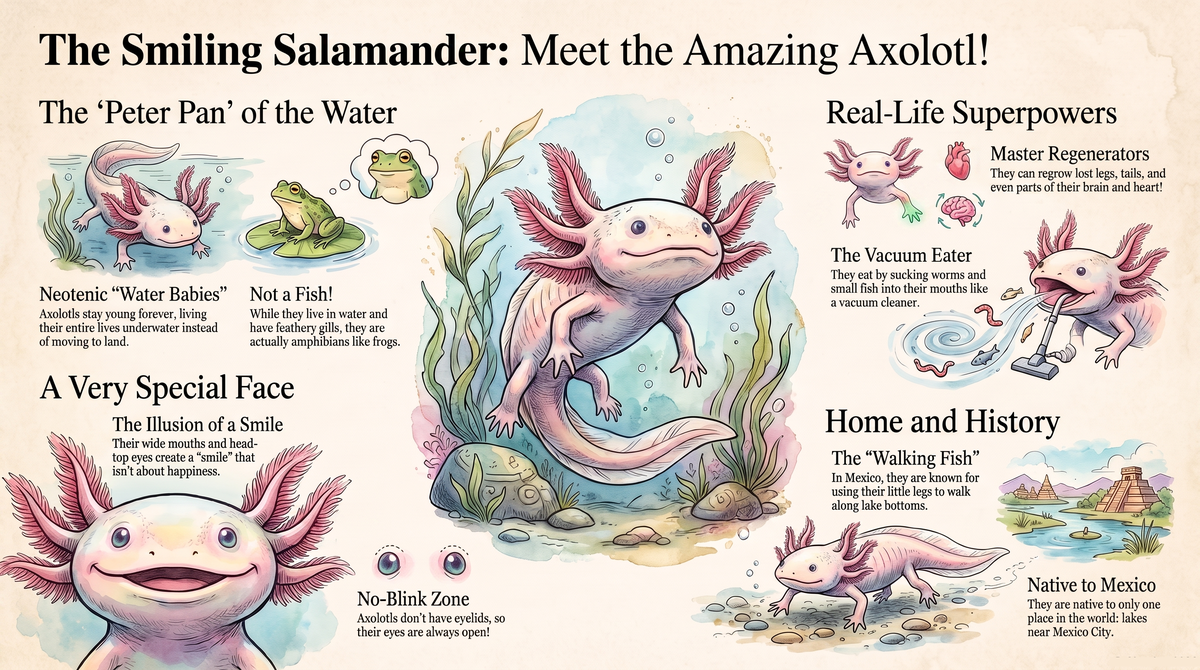
Axolotls, those famously "smiling" aquatic salamanders, can regrow entire limbs, tails, and even parts of their brain and heart. If they lose a leg, it can be back in just a few weeks, almost like magic! It’s this incredible healing ability that makes these creatures so fascinating, but their perpetually cheerful-looking faces have captured imaginations for years. So, do they really smile? Let’s find out!
1. What Exactly IS an Axolotl?
First things first, let's get acquainted with our new friends. Axolotls are a very special kind of salamander, and salamanders are a type of amphibian. Amphibians are animals that usually start their lives in water, like tadpoles, and then grow up to live on land, like frogs. But axolotls? They’re different. They skip the land-dwelling part entirely and spend their whole lives in the water. This unique trait has a fancy name: "neotenic." It’s a big word that basically means they stay in their young, aquatic form forever, never undergoing the full transformation most salamanders do. Think of them as perpetual water babies!
Fun Fact: Even though they live their whole lives underwater, axolotls are not fish! They are amphibians, just like their cousins the frogs and newts.
2. That Famous "Smile"
So, why do axolotls always look so happy? It all comes down to their faces. They have a wide mouth that curves upwards slightly, and their eyes are positioned on the top of their heads. This combination gives them a permanently cheerful expression, making them look like they’re always sporting a big grin. However, this isn't a smile born of happiness like when you get a surprise treat or play your favorite game. It’s simply how their faces are built! Their mouth shape is perfect for vacuuming up food, and their eye placement helps them spot snacks from above.
Try This at Home: Grab some paper and crayons! Draw your own axolotl. Try to capture that unique, happy-looking mouth. You can even give them a little feathery gill-headdress!
3. The Superpower of Regeneration
The "smile" might be an illusion, but axolotls have a real-life superpower: regeneration! Imagine if you could regrow a finger or a toe if you lost it. Axolotls can do just that, and much more. They can regrow lost legs, tails, and even complex parts of their bodies like their hearts and brains. Scientists are incredibly interested in this ability because understanding how they do it could lead to amazing breakthroughs in human medicine, helping us heal injuries and diseases in new ways.
Fun Fact: If an axolotl loses a leg, it can grow a brand-new one back in just a few weeks! That's super speedy healing!
4. A Rare Home in Mexico
Axolotls are native to a very specific place on Earth: the ancient lakes near Mexico City, Mexico. Sadly, in the wild, they are incredibly rare today. Their natural habitats have been shrinking and changing, making it hard for them to survive. This is why scientists and conservationists work hard to protect the remaining wild axolotl populations and study them in safe environments.
5. More Than Meets the Eye
Beyond their looks and healing powers, axolotls have other cool features. Those feathery things sticking out from their heads? Those are their gills, used to breathe underwater, and they look like fancy, frilly accessories! They also have lungs and can gulp air from the surface if they need to, showing they're adaptable water dwellers. And how do they eat? They use suction! They open their mouths quickly, creating a vacuum that sucks in small insects, worms, and tiny fish.
Fun Fact: In Mexico, axolotls are sometimes called "walking fish" because they can use their little legs to shuffle along the bottom of their watery homes.
Frequently Asked Questions (FAQ)
Q: Are axolotls really fish? A: Nope! Even though they live in water and are sometimes called "walking fish," axolotls are amphibians, just like frogs and newts. They start life in water and stay there, but they are not fish.
Q: Do axolotls actually feel happy when they look like they're smiling? A: Their "smile" is just how their faces are shaped! They have a wide mouth and eyes on top of their heads, which gives them a cheerful look, but it's not a sign of happiness like a human smile is.
Q: Can humans regrow body parts like axolotls? A: Not like axolotls can! Humans can heal and repair some tissues, and wounds can close up, but we can't regrow entire limbs or organs. Scientists are studying axolotls to see if they can learn anything that might help humans heal better in the future.
Q: Where do axolotls live in the wild? A: Axolotls are only found naturally in a few lakes near Mexico City, Mexico. Sadly, they are very rare in their natural homes today because their environment is changing.
Q: What do axolotls eat? A: Axolotls are carnivores. They eat small creatures like insects, worms, crustaceans, and tiny fish. They use suction to pull their food right into their mouths!
Turn this into action, a hands-on, printable mission made for this episode.
The Ranger Field Mission
Run this after every episode to turn listening into something your child actually keeps. Do as many steps as they have energy for — even one counts.
- 1
Say it back
Before snacks or screens, ask your Ranger to teach you the one big idea — as if you'd never heard it.
- 2
Find it in the wild
Hunt for one real example of today's idea — in the kitchen, the yard, the sky, or the sidewalk. Point at it and name it.
- 3
Make something
Draw it, build it from what's on the table, act it out, or record a 20-second “Ranger report.” Making it forces real understanding.
- 4
Ask the next question
Finish with “What's one thing the episode didn't answer?” Stick it on the fridge — that's the start of the next adventure.
This article is part of Parenting With Purpose - free tools and companion guides that turn everyday moments into real learning. Explore the Discovery Rangers podcast kits, browse The Library, or build a calm weekly rhythm with The Sunday Plan.


