
Asteroid Hunters: How We Track Space Rocks & Defend Earth
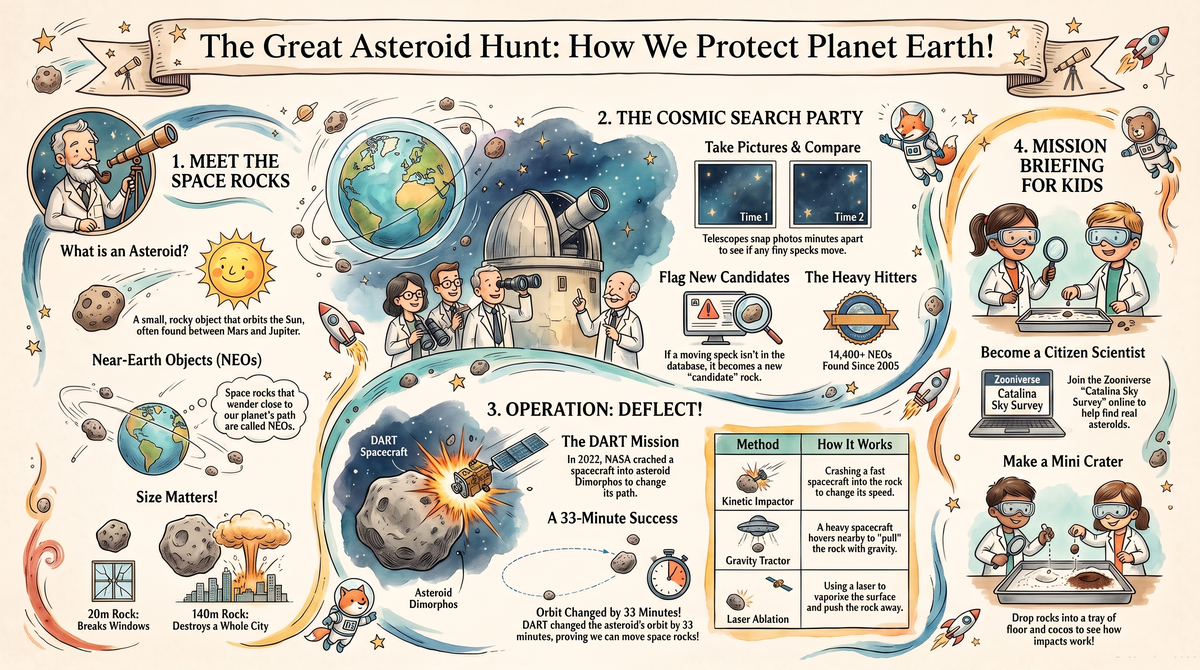
Remember those "I Spy" books, where you'd scan pages for hidden objects? Imagine playing a cosmic version of "I Spy," but instead of looking for a hidden balloon, you're searching for giant, rocky objects hurtling through space! That's exactly what today's Discovery Rangers episode is all about: the incredible work of "asteroid hunters" who keep an eye on the cosmos and protect our planet. It’s a thrilling blend of stargazing, detective work, and high-tech science, all aimed at keeping Earth safe from space rocks.
1. What Exactly Are We Looking For?
When we talk about "space rocks," we're usually referring to asteroids. Think of them as leftover building blocks from when our solar system was formed, billions of years ago. Most of these rocky travelers hang out in a big neighborhood called the asteroid belt, located between Mars and Jupiter. However, some asteroids have orbits that bring them closer to us. When an asteroid’s path gets near Earth, scientists give it a special name: a near-Earth object, or NEO for short. NEOs can also include comets, which are more like icy snowballs mixed with dust.
Fun Fact: The largest asteroid, Ceres, is so big that it's also classified as a dwarf planet! It's about 940 kilometers (580 miles) across, which is roughly the distance from Los Angeles to Denver.
2. Why All the Sky Watching?
It might seem like tiny specks in the sky are no big deal, but even small space rocks can cause significant trouble. You might remember hearing about the Chelyabinsk meteor event in 2013. This meteor, only about 20 meters (65 feet) wide, exploded over Russia. While it didn't directly hit the ground, the shockwave shattered windows and injured over 1,500 people. A rock just a bit larger, say 140 meters (460 feet) across, could flatten an entire city.
And then there are the really big ones. Millions of years ago, a massive asteroid impact is believed to have wiped out the dinosaurs! By finding and studying these NEOs early, scientists can figure out if any pose a threat and, if necessary, take action to steer them away from Earth. It’s like having an early warning system for our planet.
3. How Do We Find These Space Rocks?
Finding asteroids isn't as simple as looking up with your eyes. Scientists use powerful tools, primarily specialized telescopes, to scan the night sky. These are called survey telescopes.
Here’s how the search works:
- Take Pictures: A survey telescope is pointed at a specific patch of the sky and takes a picture.
- Take More Pictures: A few minutes later, the telescope takes another picture of the exact same patch of sky.
- Compare: Powerful computer software compares these images. If a tiny speck of light has moved between the two pictures, it's a strong clue that it's an object in orbit, not a distant star.
- Check the List: The computer then checks if this moving object is already known. If it is, it's ignored.
- New Discovery! If the moving object is not on the known list, it’s flagged as a "candidate", a potential new discovery!
Some of the major players in this hunt include the Catalina Sky Survey (CSS), which has found a huge percentage of known NEOs, and the NEOWISE space telescope, which is great at spotting asteroids by the heat they give off. A future telescope, NEO Surveyor, is planned to launch in 2027 and is designed to find 90% of NEOs larger than 140 meters.
Try This at Home: You can be a citizen scientist! Websites like Zooniverse offer projects where you can help analyze real telescope data to spot moving objects. It’s a fantastic way to contribute to real scientific discovery from your own home.
4. Tracking Down the Orbit
Once a potential NEO is spotted, the work doesn't stop. In fact, it's just beginning!
- Follow-Up Observations: Astronomers at other observatories around the world will quickly turn their telescopes towards the new object. They take more pictures over several nights.
- Calculating the Path: Each new observation gives scientists a better fix on the object's position. This information is fed into sophisticated computer programs. These programs calculate the asteroid's orbit, its exact path as it travels around the Sun.
- Predicting the Future: NASA's Center for Near-Earth Object Studies (CNEOS) is a key hub for this. They use the orbital data to predict where the asteroid will be in the future, including any close approaches to Earth over the next 100 years. Their Sentry system automatically checks all known NEOs for potential impact risks.
Fun Fact: The speed of an asteroid can vary wildly! Some move slowly, while others zip through space at tens of thousands of miles per hour. Their speed is a crucial part of calculating their orbit.
5. What Makes an Asteroid "Potentially Hazardous"?
Not all NEOs are cause for alarm. Scientists have specific criteria to identify which ones are more concerning. An asteroid is classified as a potentially hazardous asteroid (PHA) if it's larger than about 140 meters (460 feet) and its orbit brings it within about 8 million kilometers (5 million miles) of Earth. That might sound like a huge distance, but in astronomical terms, it's relatively close.
The good news is that most NEOs are discovered years, or even decades, before they might pose a threat. This gives scientists plenty of time to study them. NASA's Planetary Defense Coordination Office (PDCO) aims to have at least a 10-year warning for any large asteroid (over 140 meters) that might be on a collision course.
6. How Do We Characterize These Rocks?
Knowing an asteroid's path is vital, but scientists also need to understand the asteroid itself. They try to measure several key properties:
- Size: How big is it? Larger rocks mean more potential damage. Size is estimated from how bright the asteroid appears and, sometimes, by using radar.
- Shape and Rotation: Is it a sphere, or more lumpy? Does it spin fast or slow? A fast-spinning asteroid might even break apart. This is often figured out by studying how its brightness changes over time (its "light curve").
- Composition: What is it made of? Is it mostly rock, metal, or a mix? This helps predict how it might react if we ever needed to nudge it. Scientists use spectroscopy, which is like splitting the asteroid's light into its different colors, to figure this out.
- Surface: What's its surface like? Is it dusty, rocky, or icy? This matters for understanding how much material might be thrown off if it were to hit something. Radar imaging and spacecraft fly-bys can help reveal this.
NEOWISE's ability to see in infrared light is particularly helpful for estimating size because it measures the heat an asteroid radiates, which isn't affected by how shiny its surface is.
7. What if an Asteroid is Headed Our Way? The Planetary Defense Plan
If scientists determine that an asteroid is indeed on a collision course and meets the criteria for being a PHA, it triggers a global effort. This is where the concept of planetary defense comes in. The plan follows four main steps: Find → Track → Characterize → Deflect.
- Find: Use telescopes to discover potential threats.
- Track: Precisely calculate their orbits to predict future paths.
- Characterize: Study the asteroid's size, composition, etc.
- Deflect: If necessary, develop and execute a plan to change its course.
While this sounds like science fiction, the technology is being developed and tested. One promising method is the kinetic impactor. This involves sending a spacecraft to deliberately crash into the asteroid. The impact is designed to be just enough to slightly alter the asteroid's speed and nudge it off its collision course over time. NASA's DART mission successfully demonstrated this technique in 2022! Another idea is a gravity tractor, where a spacecraft flies alongside the asteroid for a long time; the spacecraft's own gravity would then gently pull the asteroid off course.
Protecting Earth from asteroids involves many organizations working together, including NASA for detection and deflection, FEMA for emergency response planning, and the United Nations for global coordination. It’s a team effort that spans the globe and reaches into space!
Frequently Asked Questions (FAQ)
Q: Are there asteroids that are going to hit Earth soon? A: As of now, scientists have identified all known asteroids large enough to cause global catastrophe, and none are on a collision course with Earth. They continue to find smaller objects, and the goal is to find most of the NEOs larger than 140 meters within the next decade.
Q: How do scientists know an asteroid is made of rock and not something else? A: Scientists use a technique called spectroscopy. They split the light reflected or emitted by the asteroid into its different colors, like a rainbow. Each material, rock, metal, ice, reflects and emits light in a unique pattern of colors, which acts like a fingerprint to tell scientists what the asteroid is made of.
Q: What’s the difference between an asteroid, a meteoroid, a meteor, and a meteorite? A: It all depends on where it is! A space rock is called an asteroid if it's large and orbiting the Sun, usually in the asteroid belt. If it's smaller and floating in space, it's a meteoroid. When a meteoroid enters Earth's atmosphere and burns up, creating a streak of light, we call it a meteor (or shooting star). If a piece of the meteoroid survives the trip through the atmosphere and lands on Earth, it's then called a meteorite.
Q: Could a nuclear bomb be used to destroy an asteroid? A: While it might seem like a powerful solution, using a nuclear bomb to destroy an asteroid could actually be more dangerous. It might break the asteroid into many smaller, still dangerous pieces that would spread out and hit Earth over a wider area, making the problem worse. The current focus is on nudging asteroids off course rather than breaking them apart.
Q: How do telescopes see objects that are so far away? A: Telescopes are like giant eyes that collect a lot of light. The bigger the telescope's mirror or lens, the more light it can gather. This allows it to see faint objects that are very far away. For asteroids, scientists also use very sensitive cameras and computers to detect tiny specks of light that move against the backdrop of stars.
Turn this into action, a hands-on, printable mission made for this episode.
The Ranger Field Mission
Run this after every episode to turn listening into something your child actually keeps. Do as many steps as they have energy for — even one counts.
- 1
Say it back
Before snacks or screens, ask your Ranger to teach you the one big idea — as if you'd never heard it.
- 2
Find it in the wild
Hunt for one real example of today's idea — in the kitchen, the yard, the sky, or the sidewalk. Point at it and name it.
- 3
Make something
Draw it, build it from what's on the table, act it out, or record a 20-second “Ranger report.” Making it forces real understanding.
- 4
Ask the next question
Finish with “What's one thing the episode didn't answer?” Stick it on the fridge — that's the start of the next adventure.
This article is part of Parenting With Purpose - free tools and companion guides that turn everyday moments into real learning. Explore the Discovery Rangers podcast kits, browse The Library, or build a calm weekly rhythm with The Sunday Plan.


