
Antarctica's Hidden Melt: Warm Water Under Ice Shelves
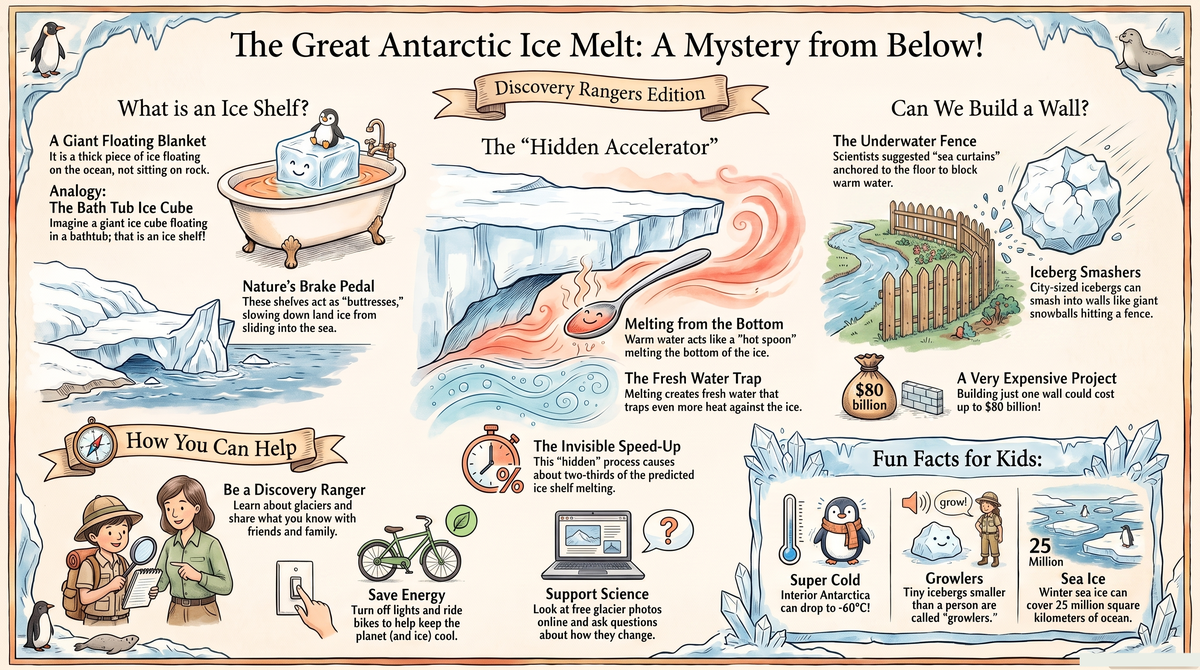
Did you know that some Antarctic ice shelves are bigger than France? Imagine a colossal sheet of ice, floating on the ocean and stretching for hundreds of kilometers. These aren't just pretty icy landscapes; they’re vital for keeping Antarctica’s massive ice sheets stable, acting like giant buttresses holding back glaciers on land. But a surprising process is happening underneath them, and it’s causing a big change.
1. What's an Ice Shelf Anyway?
Think of an ice shelf like a really, really big shelf in your room, but made of ice and floating on the ocean. It’s a huge, thick slab of ice that extends out from the land-based ice sheets of Antarctica. Some of these shelves can be as thick as two kilometers, that’s taller than many skyscrapers!
These aren't just fancy ice sculptures. Ice shelves are super important for Antarctica’s stability. They’re like giant, icy arms holding back the glaciers on land. By slowing down how fast these glaciers slide into the ocean, ice shelves keep Antarctica’s massive ice sheets in place. When an ice shelf breaks or melts, it’s like those arms letting go, and the glaciers can speed up their journey to the sea.
Fun Fact: Some of the largest ice shelves in Antarctica are bigger than entire countries, like France or Texas!
2. The Slippery Secret: Melting from Below
We often think of ice melting because of warm air, but in Antarctica, a major melt is happening underneath the ice shelves. Warm ocean water is the culprit! The ocean around Antarctica isn't all the same temperature. There’s a layer of salty, deep water called Circumpolar Deep Water that’s a few degrees warmer than the freezing point of seawater. When this "warmer" water finds its way to the underside of an ice shelf, it starts to melt the ice from below.
This melting is like a secret leak in your ceiling. You can’t see it from the outside, but damage is happening. It’s a hidden process because it’s happening miles below the ocean's surface, under kilometers of ice.
3. The Fresh-Water Feedback Loop: A Hidden Accelerator
Here’s where things get really interesting, and a bit worrying. Scientists have found a "hidden accelerator" in this melting process. When ice melts, it turns into fresh water. This fresh water is less dense, or lighter, than the salty ocean water. As more ice melts, it releases more fresh water, which mixes with the ocean water right beneath the ice shelf.
This mixing of fresh water makes the water at the base of the ice shelf lighter. Normally, dense, cold water would sit at the bottom and act like a shield, keeping the warmer Circumpolar Deep Water away from the ice. But with all the fresh meltwater, this cold, dense shield gets weaker. It’s like the warm water gets a little push, allowing it to flow more easily up towards the ice shelf’s underside and melt even more ice.
This creates a cycle: more melting leads to more fresh water, which weakens the shield, allowing more warm water to melt more ice. This "fresh-water feedback" is a powerful process. Studies suggest it might be responsible for about two-thirds of the increased melting happening at the bottom of Antarctic ice shelves! This hidden process can dramatically speed up ice loss, and scientists are concerned about what it means for global sea levels.
Fun Fact: The fresh water from melting ice is so light that it floats on top of the saltier, denser ocean water, like oil on water.
4. Why It's So Hard to Fix This Hidden Melt
If we know warm water is melting the ice shelves from below, why can't we just go and fix it? Well, Antarctica is one of the most remote and toughest places on Earth.
First off, the environment is incredibly harsh. Temperatures can drop to a bone-chilling -60°C, and the sea ice around the continent can be incredibly thick and vast, making it hard for ships and special equipment to get around. Second, the ice shelves themselves are enormous and incredibly thick, up to 2 kilometers deep! Trying to build anything or even drill through that much ice, while also working underwater and under immense pressure, is an extraordinary engineering feat.
Then there are the risks. Icebergs, some as big as cities, are constantly breaking off and drifting. Any structure placed in the water could be smashed by these icy giants. Plus, changing ocean currents, even with the best intentions, could mess with the delicate marine ecosystem that depends on the cold Antarctic waters. Because of these huge challenges, scientists have described this hidden melt process as "impossible to fix" with our current technology.
Try This at Home: Imagine you have a block of ice. You can feel how cold it is. Now, imagine that underneath that ice, there’s water that’s just a little bit warmer. What happens if you dip your finger into that warmer water and then touch the ice? It melts faster, right? This is a simple way to think about how warm water can melt ice, even if the air around it is cold.
5. The Idea of "Under-Water Walls"
Despite the difficulties, scientists and engineers are always thinking of creative solutions. One idea that’s been explored is building massive, submerged barriers, sometimes called "sea curtains" or "under-water walls." The concept is to anchor these large, flexible walls to the seafloor in key spots, like underwater canyons, to block the flow of warm Circumpolar Deep Water from reaching the underside of the ice shelves.
The idea is that by stopping the warm water from flowing up and under the shelves, the colder, denser water would stay put, acting as a better shield for the ice. Researchers are already planning to test similar "sea curtain" technologies in other important areas, like the Thwaites Glacier.
However, building these walls in Antarctica would be incredibly difficult. The scale is mind-boggling; ice shelves can be hundreds of kilometers long, meaning a protective wall would need to be just as enormous. The cost would be astronomical, potentially tens of billions of dollars. Then there’s the constant threat of icebergs, the challenge of installing such massive structures in the freezing, remote ocean, and the ongoing need for maintenance.
Plus, we have to think about the environmental impact. Changing ocean currents could affect everything from tiny phytoplankton, the base of the food chain, to krill and penguins that rely on those currents for food and survival. Because of these significant obstacles, most scientists agree that building underwater walls, while an interesting idea, isn’t a practical solution for protecting Antarctic ice shelves right now.
6. Looking Ahead
The Discovery Rangers are always exploring the cutting edge of science, and the hidden melt under Antarctic ice shelves is a prime example of a complex, natural process that is having a significant impact. While the idea of under-water walls is intriguing, the reality is that we are still learning about these processes and trying to understand their full implications. The focus for now remains on monitoring, researching, and finding ways to reduce the global factors that contribute to warming oceans in the first place.
Frequently Asked Questions (FAQ)
Q: Is the ice in Antarctica melting faster now than before? A: Yes, scientific evidence shows that ice shelves in Antarctica are melting at an accelerated rate, particularly from underneath due to warming ocean waters. This new understanding of the "fresh-water feedback" explains why this melting might be speeding up even more.
Q: Does melting ice in Antarctica affect sea levels everywhere? A: Absolutely. Antarctica holds a massive amount of frozen water. When ice shelves melt and glaciers flow faster into the ocean, the water level around the globe rises. This can lead to coastal flooding and changes in weather patterns far away from Antarctica.
Q: Can we see the warm water melting the ice from space? A: Not directly. Satellites can measure the surface of the ice shelves and see when they break or thin from the top. However, the melting happening underneath, driven by warm ocean water, is a "hidden" process that isn't visible from space and requires specialized scientific tools and models to detect and study.
Q: If we can't build underwater walls, what can we do? A: The most impactful thing we can do is address the root cause of ocean warming: climate change. This means reducing the use of fossil fuels, conserving energy, and supporting efforts to transition to cleaner energy sources. Scientists are also continuing to research and monitor the ice shelves to better predict future changes.
Q: Will penguins and seals be affected by this hidden melt? A: Yes, marine animals in Antarctica are deeply connected to the icy environment. Changes in ice shelf stability can affect sea ice formation, which is crucial for many species. Alterations in ocean currents and temperature due to meltwater can also impact the availability of food sources like krill, which are vital for penguins, seals, and whales.
Turn this into action, a hands-on, printable mission made for this episode.
The Ranger Field Mission
Run this after every episode to turn listening into something your child actually keeps. Do as many steps as they have energy for — even one counts.
- 1
Say it back
Before snacks or screens, ask your Ranger to teach you the one big idea — as if you'd never heard it.
- 2
Find it in the wild
Hunt for one real example of today's idea — in the kitchen, the yard, the sky, or the sidewalk. Point at it and name it.
- 3
Make something
Draw it, build it from what's on the table, act it out, or record a 20-second “Ranger report.” Making it forces real understanding.
- 4
Ask the next question
Finish with “What's one thing the episode didn't answer?” Stick it on the fridge — that's the start of the next adventure.
This article is part of Parenting With Purpose - free tools and companion guides that turn everyday moments into real learning. Explore the Discovery Rangers podcast kits, browse The Library, or build a calm weekly rhythm with The Sunday Plan.


