
Animal Talk: Prairie Dog Words & Whale Songs
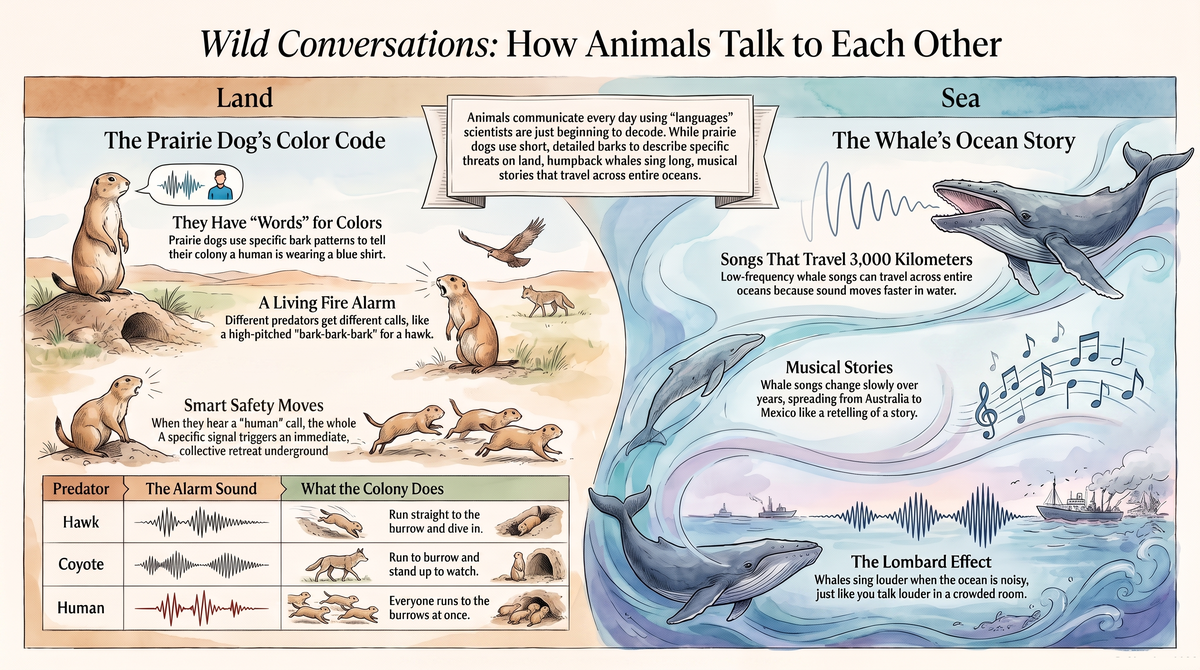
Prairie dogs have alarm calls that can tell other prairie dogs the color of a human's shirt. Pretty wild, right? We might think animals just make noise, but many are actually talking to each other in really clever ways. This week, let's explore how tiny prairie dogs can warn their friends about specific dangers and how huge whales sing songs that travel across entire oceans.
The Secret Lives of Animal Communicators
Animals need to share information to survive, just like we do. They can't exactly text or call, so they've developed their own ways of "talking." This can be anything from a bird's bright feathers to a skunk's smell, and, of course, tons of different sounds! Scientists are like detectives, listening closely to figure out what they're saying. Today, we're looking at two amazing examples: busy prairie dog towns and majestic humpback whales. Learning how they communicate helps us appreciate how smart and complex the natural world is.
Small Animals with Big Voices
Picture a busy town, but underground, with hundreds of prairie dogs instead of people! These social ground squirrels live in big family groups called colonies. Staying safe means knowing what's going on around them, and they've got an awesome alarm system.
The Prairie Dog Fire Alarm
When a prairie dog spots danger, it makes a special sound, an alarm call. Think of it as a tiny, furry alarm for the whole colony. This quick bark or chirp tells other prairie dogs something's up, and they need to act fast. But here's the really cool part: not all alarm calls are the same.
Different Dangers, Different "Words"
Scientists found out that prairie dogs don't just have one general alarm sound. They have different calls for different predators! If a red-tailed hawk is spotted, a prairie dog will bark quickly and with a high pitch. The other prairie dogs hear this and know to run for their burrows and hide underground.
If a coyote is trotting by on the ground, the alarm call sounds a bit lower and lasts longer. This time, prairie dogs run to their burrows but also pop their heads up to get a better look at the coyote. And if a pet dog gets too close, the alarm call is a repeated bark with a medium pitch. The prairie dogs will stand up and watch, only running away if the dog comes too close. This shows they can figure out how dangerous something is right away!
Fun Fact: Studies have shown that prairie dogs can even tell the difference between different kinds of humans! A sharp, urgent bark is used for people, making the whole colony dash for cover immediately.
The Mystery of the Blue Shirt
This is where it gets really mind-blowing. In one study, researchers wanted to see if prairie dogs could be even more specific. They had women walk through a prairie dog colony wearing shirts of different colors: blue, yellow, or green. The prairie dogs responded with different alarm calls for each shirt color! The "blue-shirt" call was especially different, sounding higher and longer than the others.
Scientists used a smart computer method to study these calls. They found that they could guess the color of the shirt based on the prairie dog's alarm call about 55% of the time. That's way better than just guessing!
So, they don't have a single "word" like we do for "human in a blue shirt," but prairie dogs have alarm calls that carry specific information about the danger, like its shape, size, and color. It's like they're saying, "Danger! Fast, flying danger!" or "Danger! Four-legged ground danger!" or even, "Danger! Human! And they're wearing blue!" This amazing skill helps their colony stay safe.
Try This at Home: The next time you're in a park or your backyard, watch the birds or squirrels. Do you notice them making different sounds? See if they seem to react differently to different things happening around them. You can be a scientist too!
Ocean Singers
Now, let's head into the deep ocean to meet one of its most amazing creatures: the humpback whale. These gentle giants are known for their incredible journeys and, most famously, their hauntingly beautiful songs.
The Symphony of the Sea
Humpback whale songs are long, complicated sounds that male whales repeat for minutes, or sometimes even hours. These songs are made of bigger parts called "themes," which are built from smaller "phrases." It's like a musical piece, but on a scale we can barely imagine.
Singing Across the Oceans
Sound travels much faster and farther in water than in air. This means a humpback whale's song can travel for hundreds, even thousands, of miles! A very low sound from a whale can travel over 1,900 miles, that's like sending a message from New York all the way to California! Higher sounds travel shorter distances, but they can still be heard by whales on the other side of an ocean.
Fun Fact: Humpback whales make their songs using special parts in their voice box, kind of like how humans use their vocal cords, but with much more power and a wider range.
Are Whales Telling Stories?
Scientists have noticed that whale songs aren't just random noises. They change slowly over time, and these changes can spread from one group of whales to another, like a musical trend. In the Pacific Ocean, a new song that started in Australia was heard spreading east to Hawaii and then Mexico over three years.
This way songs change and travel across huge distances makes them seem like a kind of "musical story" that goes around the world. While these songs don't name specific things or events like "blue shirt," they do seem to share important social information. Scientists think these songs are mainly used to attract mates and for whales to connect with each other, letting others know where they are and building relationships.
Responding to the Music
Experiments have shown that when recorded whale songs are played back, whales react. They are more likely to swim towards songs that sound like the ones they hear in their own area. This suggests they recognize and respond to the differences in various songs. Also, whales can change their songs to be heard over loud noises, like ships. This is called the Lombard effect, and it shows they are actively trying to communicate well.
Different Sounds, Different Purposes
It's amazing to see how these two animals, so different in size and where they live, have developed such complex ways to communicate. Prairie dogs use short, specific alarm calls to warn their colony about immediate dangers, giving details about the threat. Their calls can change quickly to deal with new situations.
Humpback whales, on the other hand, use long, changing songs mainly for mating and social connection. Their songs travel vast distances and change slowly, spreading like cultural trends across oceans. While they don't label specific things, their songs are complex and clearly mean something to other whales.
Why These Discoveries Matter for Kids
Learning about animal communication is more than just fun facts; it teaches us some important lessons:
- Animals are incredibly smart: Even the smallest creatures, like prairie dogs, can notice and communicate detailed information about their world.
- Listening is key: By watching and studying animals, we can learn about their lives and what they need.
- Nature is full of wonder: The natural world constantly surprises us with its complexity and beauty, from the tiniest bark to the grandest song.
- Respect for all creatures: Understanding how animals communicate helps us appreciate them as intelligent beings with their own unique ways of living.
So next time you hear a chirp, a bark, or even a distant rumble, stop and wonder: what might that animal be trying to say?
Frequently Asked Questions (FAQ)
Q: Do prairie dogs really have a "word" for a human wearing a blue shirt? A: Not exactly a "word" like we use it, but they have a specific alarm call pattern that contains information about the color blue. Scientists can often tell what color shirt a human was wearing based on the prairie dog's alarm call, meaning the call conveys that specific detail about the threat.
Q: How can whale songs travel so far through the ocean? A: Sound travels much faster and farther in water than in air. Humpback whale songs are often very low-pitched, which allows these specific frequencies to travel hundreds or even thousands of miles across the ocean basins, reaching whales very far away.
Q: Are whale songs like human music, with melodies and rhythms? A: Whale songs are very structured and have repeating themes and phrases, which can sound musical. They evolve over time, and patterns spread among whale populations, similar to how musical trends can spread among people. However, they are not thought to be for entertainment but rather for mating and social communication.
Q: Do prairie dogs only make alarm calls, or do they "talk" about other things? A: While alarm calls are the most studied form of prairie dog communication, they do make other sounds for different social interactions, such as greeting calls or calls related to mating. Scientists are still working to understand the full range of their vocalizations and their meanings.
Q: Can we ever truly understand what animals are saying? A: We can understand a lot about animal communication by observing their behaviors and analyzing their sounds, colors, and smells. For example, we know prairie dog alarm calls convey specific threats, and whale songs are important for social bonding. However, the subjective experience of "what it's like" to be a prairie dog or a whale, or to have their specific thoughts and feelings, may always remain a mystery to us.
Turn this into action, a hands-on, printable mission made for this episode.
The Ranger Field Mission
Run this after every episode to turn listening into something your child actually keeps. Do as many steps as they have energy for — even one counts.
- 1
Say it back
Before snacks or screens, ask your Ranger to teach you the one big idea — as if you'd never heard it.
- 2
Find it in the wild
Hunt for one real example of today's idea — in the kitchen, the yard, the sky, or the sidewalk. Point at it and name it.
- 3
Make something
Draw it, build it from what's on the table, act it out, or record a 20-second “Ranger report.” Making it forces real understanding.
- 4
Ask the next question
Finish with “What's one thing the episode didn't answer?” Stick it on the fridge — that's the start of the next adventure.
This article is part of Parenting With Purpose - free tools and companion guides that turn everyday moments into real learning. Explore the Discovery Rangers podcast kits, browse The Library, or build a calm weekly rhythm with The Sunday Plan.


