
Ancient Games & Dice: The Oldest Board Game in the World
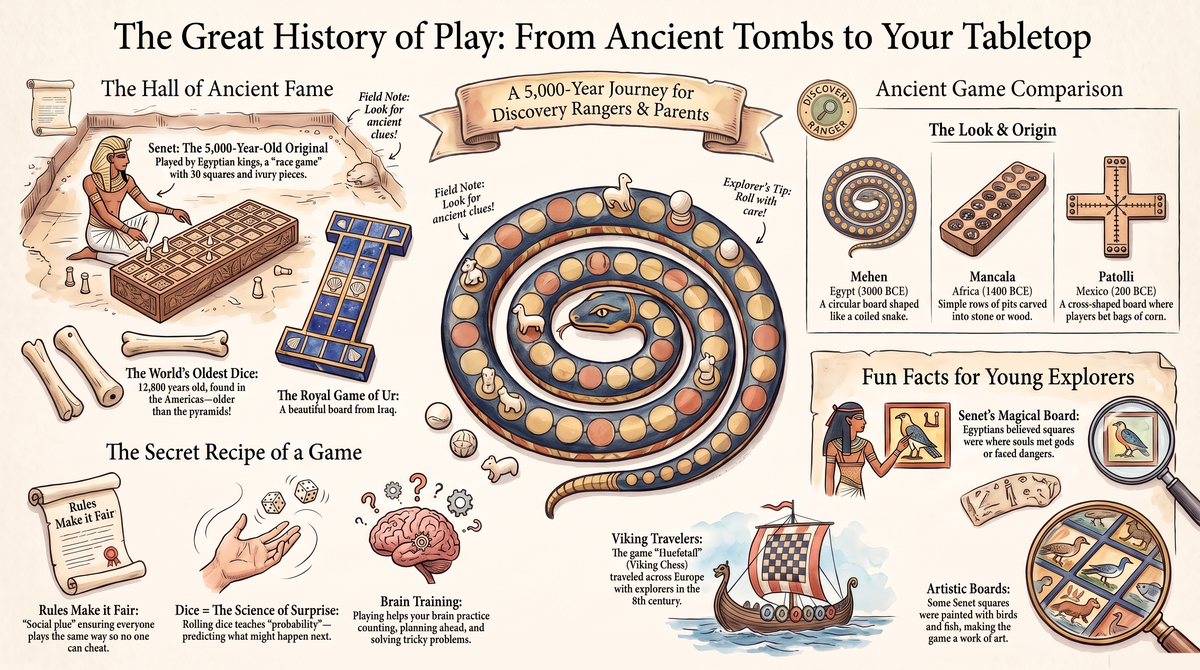
Imagine a world without screens, without even paper as we know it. Yet, over 5,000 years ago, in ancient Egypt, people were gathering around boards, moving pieces, and playing games. The star of our show today is Senet, a game so old that it's considered the world's oldest known board game. Archaeologists have found Senet boards in the tombs of pharaohs and in the ruins of ordinary homes, proving its widespread popularity.
What did Senet look like? Picture a board with 30 squares, arranged neatly in three rows of ten. Players would move small carved pieces, likely made of stone or ivory, across these squares. The ultimate goal? To be the first to guide all your pieces off the board. Senet was more than just a pastime; it was deeply embedded in Egyptian culture. It appeared in ancient paintings and was even mentioned in the Book of the Dead, an important guide for the afterlife. The squares on the board were thought to represent a soul's journey, a path where they might encounter gods or face challenges on their way to the next world.
Fun Fact: Some historians believe that Senet wasn't just a game of chance, but also a game that represented the journey of the soul through the underworld, making every move potentially significant for eternity!
2. A World of Ancient Play: More Than Just Senet
While Senet might hold the title of the oldest, it wasn't the only game captivating ancient minds. As we explore the archaeological record, we find evidence of other fascinating games emerging around the same time and shortly after, in different corners of the world.
In ancient Mesopotamia (modern-day Iraq), around 2600 BCE, people were playing the Royal Game of Ur. This game, found in the Royal Cemetery of Ur, featured about 20 squares arranged in a distinctive "I" shape. Unlike Senet, the Royal Game of Ur definitely involved dice, often made from animal bones or small stones.
Meanwhile, back in Egypt, another unique game called Mehen was being played. Dating back to around 3000 BCE, Mehen had a circular board shaped like a coiled snake, with players moving their pieces along the snake's body.
Further south, in East Africa, the origins of Mancala can be traced. The oldest known stone boards with rows of pits for Mancala date back to 1400 BCE, but some scholars suggest the game could be as old as 6,000 years, given the discovery of similar pits in much older archaeological sites.
In Mesoamerica (modern-day Mexico), around 200 BCE, games like Patolli were popular. Played by the Aztecs and Maya, Patolli used a cross-shaped board and players rolled "bean dice", beans marked with spots, to determine their moves.
And in Europe, a game called Nine Men's Morris, with its distinctive three concentric squares and connecting lines, has been found on Egyptian temple stones from 1440 BCE, later appearing on Roman and medieval European boards.
These discoveries paint a vibrant picture: humans across vast distances and diverse cultures were independently inventing games, driven by a shared desire for entertainment, challenge, and social connection.
3. The Magic of Dice: Adding Chance and Excitement
What do Senet, the Royal Game of Ur, and Patolli have in common? Many of these ancient games, and nearly all games that followed, incorporated an element of chance, often through the use of dice. But why were dice so important?
Dice are essentially small objects designed to land on different sides, introducing an element of the unpredictable. The word chance means something that cannot be predicted, and that's exactly what dice bring to a game. When you roll a die, you don't know if you'll get a high number or a low number. This element of surprise is what makes games exciting and keeps players on the edge of their seats.
The earliest dice weren't the perfect cubes we see today. Ancient dice were often made from animal bones, stones, or wood, and could have various shapes. The Chinese, for example, were making four-sided dice (tiny tetrahedrons) as early as 3000 BCE, a shape similar to those used in the Royal Game of Ur. In the Americas, players used "bean dice," and Native Americans were using two-sided bone pieces, known as binary lots, as early as 12,800 years ago, far earlier than many Old World dice!
Fun Fact: The concept of "binary lots" used by ancient Native Americans is similar to how we use coin flips today to make a 50/50 decision, demonstrating a very early understanding of probability!
4. The Power of Rules: Making Games Fair and Fun
While chance adds excitement, it's rules that transform random activity into a structured game. A rule is simply a guideline that tells players what they can and cannot do. Without rules, games would quickly descend into chaos, and one player could easily cheat, making the game unfair and no longer fun.
Think about it: if there were no rules in tag, how would you know who is "it"? If there were no rules in a card game, how would you know how to score points? Ancient games, just like modern ones, relied on a clear set of rules to ensure that everyone played by the same standards. These rules helped to create a level playing field, allowing skill and luck to determine the outcome.
Many ancient games, even those with dice, also required strategy. Strategy means thinking ahead and planning your moves to gain an advantage. Playing these games helped ancient people practice important skills like counting, planning, and problem-solving, skills that are just as valuable in life today as they were thousands of years ago.
Try This at Home: Invent your own simple game with your child! Start by deciding on a goal (e.g., reach the end of a drawn path). Then, create a simple "die", you could use a small pebble and mark one side with a dot, or fold a small piece of paper to create a spinner with two options. Finally, write down 1-2 simple rules together. Play your game and see how the rules and chance work together!
5. Games as Social Glue: Connecting People Through Play
Beyond the thrill of chance and the challenge of strategy, games have always served a vital social purpose: they bring people together. In ancient times, a board game could be a way for a king to interact with a traveler, or for children to play together while adults were busy. Games provided a safe and structured environment for people to talk, laugh, and share experiences.
This social aspect is what makes games true social glue. They can bridge gaps between different people, cultures, and generations. The way games spread across continents, as we've seen with examples like Nine Men's Morris traveling from Egypt to Europe, or Viking games like Hnefatafl spreading through northern Europe, shows that games traveled with people. Traders, soldiers, and families carried their favorite games with them, sharing them with new communities. As these games moved, they often adapted, incorporating local customs and materials, becoming a part of the new culture while retaining their fundamental joy.
So, the next time you sit down for a board game with your family, remember that you're participating in a tradition that stretches back to the very dawn of civilization, connecting you to countless generations of players who found fun, challenge, and connection through the simple magic of games.
Frequently Asked Questions (FAQ)
Q: What is the oldest board game ever discovered? A: The oldest board game discovered by archaeologists is called Senet, which originated in ancient Egypt over 5,000 years ago, around 3100 BCE.
Q: How was Senet played? A: Senet was played on a board with 30 squares arranged in three rows of ten. Players moved small pieces across the board, aiming to be the first to get all their pieces off. The game's squares were thought to have symbolic meaning related to the journey through the afterlife.
Q: Were dice used in ancient games? A: Yes, dice were used in many ancient games. Early dice were often made from animal bones or stones and came in various shapes. Games like the Royal Game of Ur and Patolli specifically used dice to determine player moves.
Q: How did games spread to different parts of the world? A: Games traveled with people! Traders, soldiers, and families moving between regions often brought their games with them. As these games were shared, they sometimes adapted to fit new cultures and traditions.
Q: Why are games important for kids? A: Games are important because they help children develop crucial skills. They teach counting, planning, and problem-solving through strategy. They also introduce the concept of chance and the fairness of rules, and most importantly, they provide a wonderful way for families and friends to connect and share time together.
Turn this into action, a hands-on, printable mission made for this episode.
The Ranger Field Mission
Run this after every episode to turn listening into something your child actually keeps. Do as many steps as they have energy for — even one counts.
- 1
Say it back
Before snacks or screens, ask your Ranger to teach you the one big idea — as if you'd never heard it.
- 2
Find it in the wild
Hunt for one real example of today's idea — in the kitchen, the yard, the sky, or the sidewalk. Point at it and name it.
- 3
Make something
Draw it, build it from what's on the table, act it out, or record a 20-second “Ranger report.” Making it forces real understanding.
- 4
Ask the next question
Finish with “What's one thing the episode didn't answer?” Stick it on the fridge — that's the start of the next adventure.
This article is part of Parenting With Purpose - free tools and companion guides that turn everyday moments into real learning. Explore the Discovery Rangers podcast kits, browse The Library, or build a calm weekly rhythm with The Sunday Plan.


