Ancient Egyptian Kids: What They Ate, Played, and Learned
Breakfast in ancient Egypt? A cup of beer. For a ten-year-old.
Hold on. it's not what you think. Roll the clock back about 4,000 years to a kid your age living beside the Nile River, and almost everything looks bizarre to us. Their juice box was a mug of thick barley brew. Their favorite board game raced little pieces into the afterlife. And school meant learning to write with tiny pictures of birds and snakes. Let's go meet them.
1. A Cup of Beer With Breakfast (Really)
Picture your fridge and pantry. Now empty them out, because almost nothing in there existed yet. For a kid on the Nile, every meal started with one thing: bread.
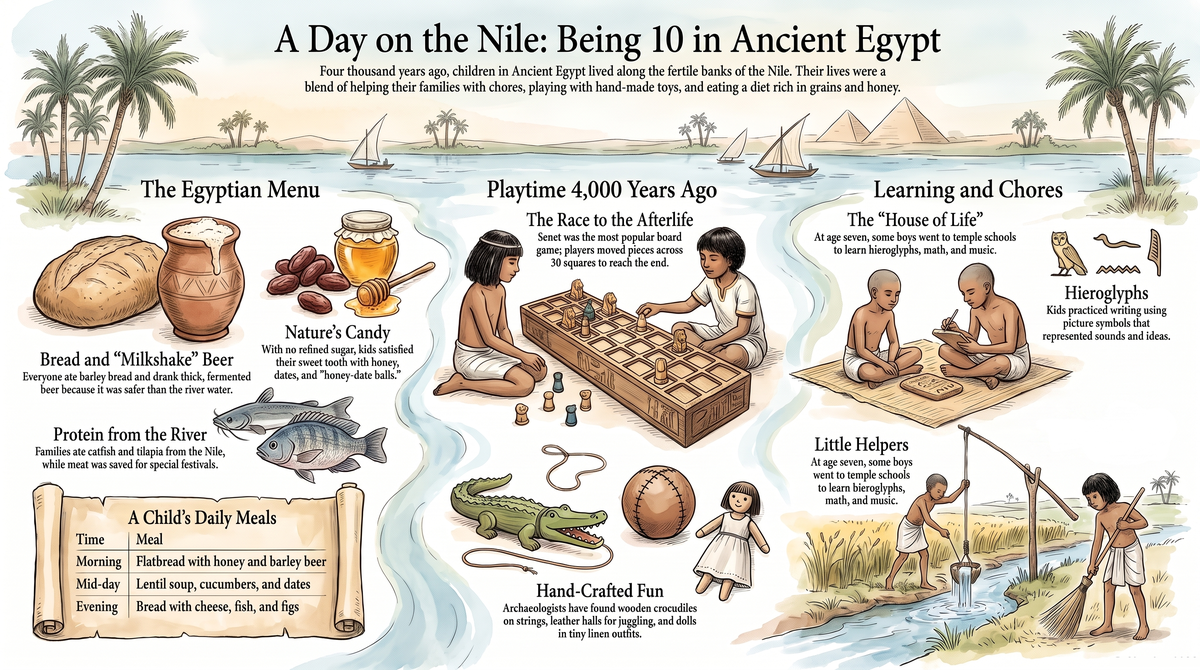
This wasn't soft, squishy sandwich bread. It was made from tough grains like barley and emmer wheat, mixed with water and a pinch of salt, and sometimes shaped into animals or little people for fun. And to drink? Beer. But not grown-up beer, this was thick and gloopy, almost a barley milkshake, with barely any of the stuff that makes adult beer adult. Why beer instead of water? Because plain Nile water could make you sick, and the brewing made the beer safer to drink. Smart, gross, and a little bit funny all at once.
Where did the rest of the food come from? The Nile, basically. Every year the river flooded and left behind a layer of rich black mud called silt. nature's free fertilizer. That magic mud grew onions, garlic, lettuce, cucumbers, radishes, beans, and lentils. Fruit was the sweet treat: dates, figs, grapes, melons, pomegranates. Need protein? Fishermen pulled catfish and tilapia straight out of the river. Beef and duck existed too, but those were fancy. special-occasion food for rich families and festivals.
Fun Fact: Egyptians had zero refined sugar. no candy, no soda, none of it. So how'd they get a sweet fix? Honey from bees, and sticky-sweet dried dates and figs. They'd mash dates with honey into little sweet balls. Ancient dessert, invented.
Curious what a whole day of eating looked like for a 10-year-old?
- Morning: Flatbread with a drizzle of honey, washed down with that barley beer.
- Mid-day: A warm bowl of lentil soup with onions, some cucumber slices, a few dates.
- Afternoon: Grilled fish, or duck, if the family had money.
- Evening: Bread with cheese, a handful of figs, and water from a well.
2. Racing to the Afterlife (It's a Board Game)
Egyptian kids loved board games. And their #1 favorite had a wild goal: get your pieces safely to the land of the dead.
It was called Senet, and it's older than the pyramids of Giza. people were playing it around 2600 BCE. You moved your pieces across a board of 30 squares, racing to reach the "afterlife" side first. Egyptians took it seriously. They buried Senet boards right in people's tombs, so the dead could keep playing forever. There were other games too: Mehen, played on a board coiled up like a snake, and Aseb, a 20-square game where you threw sticks instead of rolling dice. Grown-ups played all of these right alongside the kids.
When they weren't gaming, kids reached for toys that archaeologists still dig up today:
- Dolls of cloth, wood, or clay. some dressed in tiny linen outfits.
- Wooden animals like horses and crocodiles, some on strings so you could pull them along.
- Balls made of leather or woven papyrus, for tossing and juggling.
- Marbles of stone or clay, played pretty much the way you'd play today.
- Slingshots of plant fiber and stone, for flinging pebbles and practicing aim.
Fun Fact: A lot of those "toys" were secretly training. Flinging stones with a slingshot or steering a pull-along animal built the hand-eye coordination kids would later need for real hunting and herding. Playtime was practice.
And plenty of play didn't need any toys at all. Kids ran, wrestled, swam in the Nile, and spun each other dizzy in a game called "round-about." Same energy as a playground today. just a few thousand years earlier.
Try This at Home: Build your own version of Senet. Draw a grid of 30 squares on cardboard or paper. Grab bottle caps, pebbles, or LEGO pieces for your players. Make "dice" by marking dots on small stones or a folded scrap of paper. Then invent your own rules. what's the goal? What sends a piece backward? Play a round with someone and tweak the rules until it's actually fun.
3. School at the House of Life
Not every kid got to go to school. Back then, learning to read and write was a privilege, mostly for children from wealthy families. Boys usually started around age seven at a temple school with an awesome name: the House of Life.
What did they study? Loads. Most of the day went to reading and writing. first the famous picture-writing called hieroglyphs, then a faster, scribbly script for everyday notes. They learned math too: arithmetic and geometry, the exact skills you'd need to build a pyramid, measure a field, or figure out taxes. There was even time for music and art. The dream job at the end of all this? Becoming a scribe, the trusted person who wrote the records, letters, and official documents that kept the whole kingdom running. It took years of hard work, but it earned you respect and a good life.
What about everyone else? Most kids learned at home, by doing. Girls especially picked up skills like weaving, cooking, and running a household. And no matter who you were, you had chores. Little kids fetched water and gathered firewood. Bigger kids helped harvest crops, looked after animals, or learned the family trade. Everybody pitched in. that's just how it worked.
Frequently Asked Questions (FAQ)
Q: Did all ancient Egyptian kids go to school? A: No, formal schooling was mainly for boys from wealthier families. Girls and children from poorer families usually learned skills at home or through apprenticeships.
Q: What was the most important food in ancient Egypt? A: Bread was the most important staple food for everyone, rich or poor. Beer was also a very common daily drink.
Q: Were there any sweet treats for kids in ancient Egypt? A: Yes! Instead of refined sugar, they used honey and naturally sweet dried fruits like dates and figs to make sweet treats, cakes, and pastries.
Q: What kind of toys did ancient Egyptian children play with? A: They played with a variety of simple toys, including dolls made of cloth or clay, wooden animal figures, balls, marbles, and even slingshots. They also enjoyed board games like Senet.
Q: Was it dangerous for kids to swim in the Nile River? A: The Nile River was a source of life, but it could also be dangerous. While children did swim in it, they were likely taught to be aware of strong currents and the presence of crocodiles. Drinking the river water could also be risky, which is why beer was often a safer beverage choice.
The Ranger Field Mission
Run this after every episode to turn listening into something your child actually keeps. Do as many steps as they have energy for — even one counts.
- 1
Say it back
Before snacks or screens, ask your Ranger to teach you the one big idea — as if you'd never heard it.
- 2
Find it in the wild
Hunt for one real example of today's idea — in the kitchen, the yard, the sky, or the sidewalk. Point at it and name it.
- 3
Make something
Draw it, build it from what's on the table, act it out, or record a 20-second “Ranger report.” Making it forces real understanding.
- 4
Ask the next question
Finish with “What's one thing the episode didn't answer?” Stick it on the fridge — that's the start of the next adventure.
This article is part of Parenting With Purpose - free tools and companion guides that turn everyday moments into real learning. Explore the Discovery Rangers podcast kits, browse The Library, or build a calm weekly rhythm with The Sunday Plan.


