
Amazing Axolotls: The Underwater Superheroes
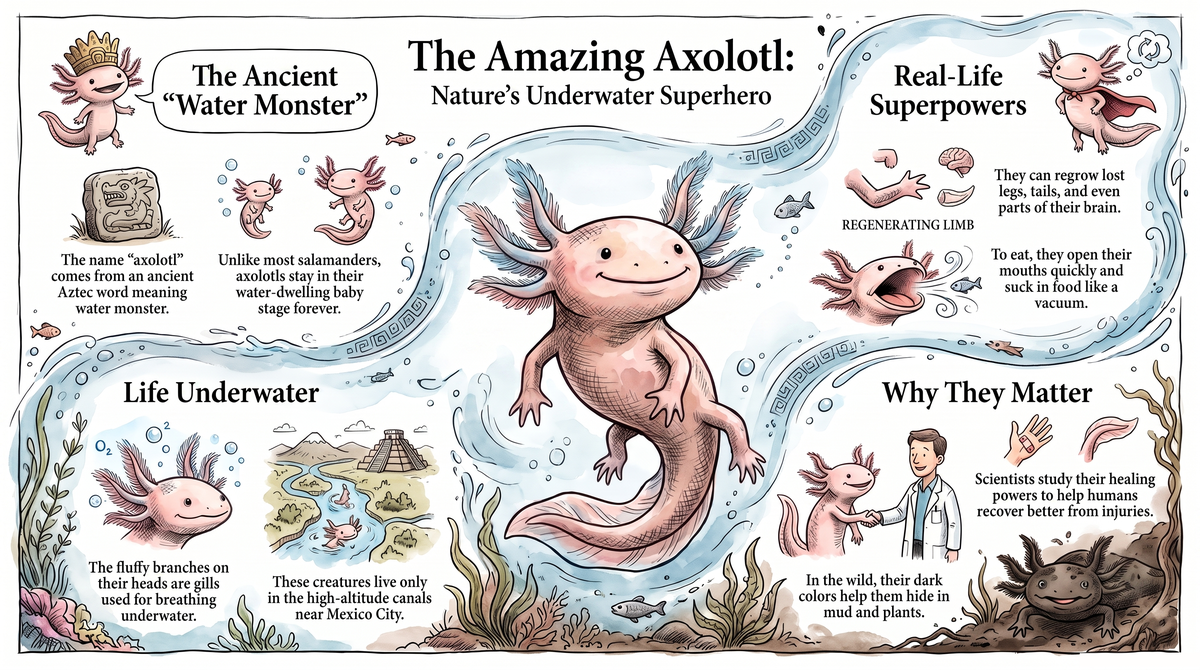
1. Meet the "Water Monster" Who Never Grows Up
Imagine a creature with fluffy, feathery gills sticking out of its head like a crown, a permanent smile plastered across its face, and the incredible ability to regrow an entire leg, or even a piece of its heart! That’s an axolotl, a tiny amphibian from Mexico that sounds like it leaped right out of a superhero comic book. Unlike most salamanders that eventually ditch their aquatic homes for land, axolotls are stuck in a perpetual state of "babyhood," staying underwater and keeping those cool external gills their entire lives. Their ancient name, "axolotl," even means "water monster" in the Aztec language, though these gentle creatures are anything but monstrous.
2. Where Do These Water Wonders Live?
Axolotls aren't found just anywhere. They are super specialized, native only to a very specific corner of the world: the ancient lake system near Mexico City, Mexico. For a long time, their home was the vast Lake Xochimilco. Today, they mostly hang out in the remaining canals and waterways of that area. Think of it like a very exclusive club for these unique amphibians. Their habitat is a crucial part of their story, and sadly, it's a habitat that's facing big challenges.
3. The Superpower of Regeneration
This is where axolotls really earn their superhero status. They possess an astonishing ability called regeneration. This means if an axolotl loses a limb, maybe in a scuffle with another creature or an accident, it doesn’t just heal; it regrows a brand-new, perfectly functional leg. And it’s not just legs! They can regenerate their tails, their eyes, and even parts of their vital organs like their brain and heart. Scientists are absolutely fascinated by this ability because it’s so much more advanced than how humans heal.
Fun Fact: If you’ve ever scraped your knee, you know it heals, but it doesn't grow back a whole new knee! Axolotls can do something similar with many parts of their bodies, which is why scientists study them so closely.
4. What Do These Superheroes Look Like?
Axolotls have a look that’s all their own. Those feathery external gills, often bright pink or red, are their most striking feature. They fan out from the sides of their heads, looking like a fancy, living headdress. Their mouths are wide and curve upwards, giving them a perpetually happy, smiling appearance, even when they’re just hanging out on the bottom of the lake. While wild axolotls are often dark brown or black to blend in with their surroundings, the ones you might see in aquariums or labs can come in a rainbow of colors, including pale pink, white, and even golden hues.
5. How Do Axolotls Eat?
These underwater dwellers are carnivores, meaning their diet consists of other animals. In their natural habitat, they dine on small insects, worms, tiny crustaceans, and even small fish. They have a rather unique way of catching their meals. When an axolotl spots a tasty morsel, it opens its mouth incredibly quickly, creating a sudden suction. This vacuum-like action pulls water and the unsuspecting food item right into its mouth. It's an efficient way to snag a meal in the murky waters.
Try This at Home: Grab a straw and a small bowl of water with a few tiny floating objects (like small bits of paper or tiny plastic beads). Try to suck up one of the objects with the straw. How does the suction work? Can you imagine an axolotl doing something similar, but much faster and more powerful, to eat its food?
6. Why Are Axolotls So Important?
Axolotls are more than just fascinating creatures; they hold significant importance for both science and their native ecosystem. Their incredible regenerative abilities make them living laboratories for scientists hoping to understand how to improve healing in humans. By studying how axolotls regrow complex tissues, researchers might one day discover ways to help people recover from injuries or diseases more effectively.
Beyond the lab, axolotls are a vital part of the delicate ecosystem in the canals of Mexico City. They help keep insect and small fish populations in check. However, their numbers in the wild have drastically declined, making them an endangered species. Protecting their habitat and ensuring their survival is crucial for the health of their unique environment and for the future scientific discoveries they hold.
Frequently Asked Questions (FAQ)
Q: What is an amphibian, and how are axolotls different? A: Amphibians are animals that typically start their lives in water (like tadpoles) and then develop lungs and legs to live on land as adults. Think of frogs and toads. Axolotls are amphibians too, but they are special because they stay in their larval, water-dwelling stage their entire lives, keeping their gills and never moving onto land. This is called "neoteny."
Q: Can an axolotl really regrow its entire body? A: No, they can't regrow their entire body from a tiny fragment like some fictional superheroes. However, they can regenerate large and complex parts, like a whole leg, tail, eye, or even significant portions of their heart and brain. It's an amazing feat of nature!
Q: Are axolotls dangerous to humans? A: Not at all! Axolotls are very gentle and shy creatures. They are not aggressive and pose no threat to people. Their "water monster" name comes from their ancient origins and unique appearance, not from any dangerous behavior.
Q: Why are axolotls endangered, and what does that mean? A: Axolotls are endangered because their natural habitat in the lakes and canals around Mexico City has been heavily damaged and polluted. There isn't enough clean water and suitable space for them to live and reproduce safely. "Endangered" means that a species is at a very high risk of extinction in the wild if conservation efforts aren't successful.
Q: Where can I see an axolotl? A: In the wild, seeing an axolotl is extremely rare due to their low numbers and shy nature. However, many aquariums and science museums have axolotls on display. Some people also keep them as pets in specialized aquariums, but it's important to remember they require very specific care to thrive.
Turn this into action, a hands-on, printable mission made for this episode.
The Ranger Field Mission
Run this after every episode to turn listening into something your child actually keeps. Do as many steps as they have energy for — even one counts.
- 1
Say it back
Before snacks or screens, ask your Ranger to teach you the one big idea — as if you'd never heard it.
- 2
Find it in the wild
Hunt for one real example of today's idea — in the kitchen, the yard, the sky, or the sidewalk. Point at it and name it.
- 3
Make something
Draw it, build it from what's on the table, act it out, or record a 20-second “Ranger report.” Making it forces real understanding.
- 4
Ask the next question
Finish with “What's one thing the episode didn't answer?” Stick it on the fridge — that's the start of the next adventure.
This article is part of Parenting With Purpose - free tools and companion guides that turn everyday moments into real learning. Explore the Discovery Rangers podcast kits, browse The Library, or build a calm weekly rhythm with The Sunday Plan.


